sml logo Dark Ages Re-Creation Company sml logo

Tuesday, September 3, 2024

Our Camp at “Ribe” is Closed for the Season

DARC had a new place to set up camp for this year’s Labour Day long weekend so we imagined coming to the Viking-Age commercial centre of Ribe (in what is now Denmark) as traders and artisans. Trading was a seasonal activity, but people would come for several months each year. This allowed us to have a “camp” but also produce things rather than just “sell”.  

Ragnar and Kettil ran the bead furnace with the assistance of Fion on the bellows, and visitors were invited to try their hand at making a bead. The furnace broke part-way through thanks to a gust of wind that knocked a pole into it, but they were able to mend it and continue. There were also issues with the charcoal, but once they switched to a different charcoal they did manage to produce a few beads.

Thorgeir turned bowls on his pole lathe.


Jhone worked on her warp-weighted loom when she wasn’t cooking, and several visitors had fun weaving under her supervision. Herr she is chatting with Kadin, who is also a skilled textile worker.


Ælfwyn spent the day making enamelled items.
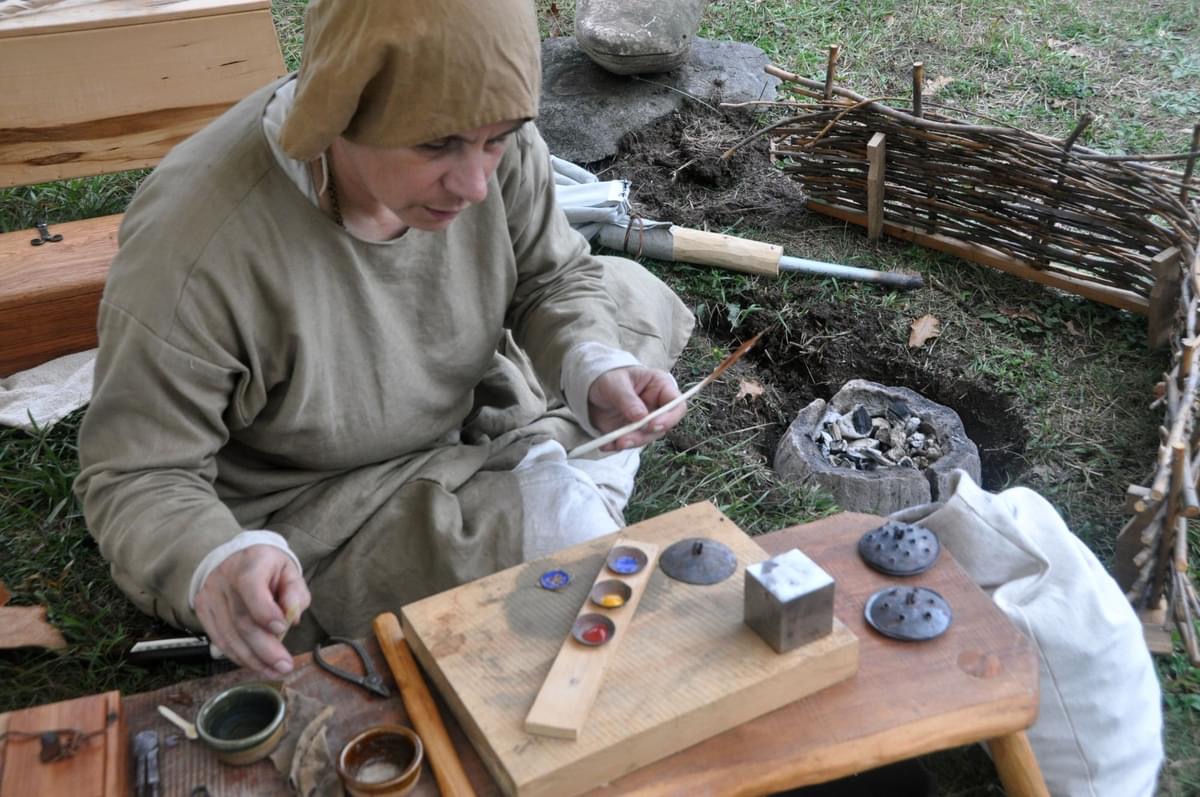
Auðr mostly puttered around the hearth, making butter, fixing some kitchen tools to be more useful, and making a new wooden spatula.


We have some ideas on how to make our “street” more accessible to visitors while retaining the model of workshops in front of sleeping areas, but overall we were pleased with how it worked.

Monday, September 2, 2024

Nålbinding

It was chilly last night so Kaðlin was wise to spend much of the last two days making herself a new nålbound cap using wool she had dyed and spun herself. She is using a simple loop stitch. The pink comes from madder while the blue is indigo over dyed with weld. While indigo was not found in the Viking Norse areas, chemically it is the same as weld, which was.


Sunday, September 1, 2024

Iron

Today I happened to sit through a class on iron by Kettil (Darrell Markewitz).

He talked about sources of iron, the basic processes to extract ore and turn it into iron, softer (easier to work), vs hard (holds an edge but brittle) and how both would be incorporated into things like knives or axes.

He also talked about the quality of iron produced and showed objects to demonstrate how it was used.

The most striking figure for me (Auðr) was the average amount of iron per person in a household: 2 kg. What that meant was you would have a personal knife but not much more. A ship needed around 2000 nails. Your household would likely have an axe, maybe some metal-edged farming implements, a cooking pot, and possibly  a bit more stuff like a cauldron hangar, pan or fork, depending on the size of the household. Things like fry pans and forks may have had wooden handles. A shovel would be wood with just a metal edge on the digging part.


Darrell has literally tons of experience making iron. 
2,500 kg of ore used
Just under 5,000 kg of charcoal
81 blooms totalling over 475 kg of iron
72 furnaces (some of which were reused for more than one smelt)
95 smelts
36 different kinds of ore
20 different kinds of furnaces to explore different styles and techniques based archeological remains
16 different kinds of air sources

He has a book coming out later this year to document his 25 years of historical iron smelting and what we expect to be over 100 smelts by the time of publication. Until then, you might be interested in one of his other books:
 

DARC is getting more active on social media

 Dear readers,

We had a hard time moving from the first millennium CE to the modern world: futhark to megBytes.

We’re on Threads and Instagram as @dark_ages_recreation_company.

You can also find us on Bluesky as https://bsky.app/profile/darc-company.bsky.social

And we’re on Facebook at The Norse Company 

Thorgeir in an intense conversation over preparations for a living history presentation.

Sunday, February 17, 2019

DARC at Upper Canada Village : 2018

These images are just some of the ones made by Kelly Probyn-Smith, at DARC's 2018 presentation at Upper Canada Village Medieval Festival.

From the rear of Camp : Beadmaking & Foodways
Rear section of Camp : Foodways / Carving / Woodworking
Beadmaking
Cordwork with tent interior
Foodways
Treadle Lathe
Warp Weighted Loom
Metalworking
Story Telling / Music with tent interior
Woodworking / Carving
Spinning with tent interior

These images were selected (by me) from a very large number (about 200) as ones that best illustrated the primary activities demonstrated in our presentation.  Also chosen with an eye to showing interaction with the public. (Also attempting have at least fairly good images of the individual members themselves - not always easy to achieve all three factors!)

The reason for undertaking this is that this year UCV is requiring all involved to submit a formal 'Request for Quotes' document. This includes images showing the overall camp, individual demonstrations and public involvement. This is likely more a formality than a competition in the case of DARC. There simply is no other Viking Age re-creation group in Canada with our depth of presentation experience and individual research.

Tuesday, September 11, 2018

Come to CAMELOT

http://dragenlab.ca/camelot-conference/

A number of people who are involved in DARC's experimental archaeology projects will be delivering sessions at the conference (marked with bold type below)

Darrell will be undertaking a full demonstration bloomery iron smelt as part of the 'outreach' side of this coming weekend's new CAMELOT conference:
The building a 'norse short shaft' furnace on FRIDAY.
The full smelting process will be undertaken SUNDAY, with extraction of the bloom intended for roughly the end of the day's sessions (about 5 pm +).

There will be some limited opportunities for conference members to directly participate. Those hoping to become involved should come dressed in 'work clothes' (must be all natural fibre, leather boots). Other safety gear will be provided.

This marks the first time this experimental archaeology process has been demonstrated at an academic conference in Canada.


CAMELOT is the continuation of the long running 'Forward Into the Past' event.
For it's initial year, registration for the conference is FREE (via their web site).

The core of the conference is a full series of academic type paper presentations, by senior students, independent researchers, and academics. This allows for topics of interest to a wide range of people, from the general public through to the professional.

This is the published outline of sessions :


CAMELOT
Preliminary Conference Schedule
Session 1: Military
9:00 - 10:30
·       Damien Cole – The fyrd: Anglo-Saxon military organisation, recruitment, and the                                         deployment of different types of units on the ancient English battlefield

·       Daniel Hutter – The Varangian Guard
·       Ben Hennin - influences of Homeric/Roman Epic poetry on the medieval Song of Roland
Session 2: Archaeology
10:45 – 12:15
·       Andrew Moore - Archaeology and the Hill Figures of England: Ancient Giants or Early                                                                     Modern Satire?

·       Rachel Cogswell – Exploring Non-Ferrous Metalworking in Sweden, 500 – 798 CE
·       David Miles – The art of smithing: social perspectives of practitioners in the Middle Ages
Session 3: Travel
10:45 – 12:15
·       Daphne Van Delst –Medieval Badges
·       Augustine Dickinson – Ethiopian manuscripts: importance and analyzation
·       Alexander Bucholtz – King Sigurd I of Norway: Scandinavian participation in Iberian and Middle Eastern crusading
Session 4: Demonstrations
1:30 - 2:15
·       Wendy Maurice – How I grew a Tunic
·       Jean RossThe Making of a Treasure Necklace based upon the Hon Hoard
·       Colleen Moynham – Brass Rubbing
Session 5: A Medieval Miscellany
2:30 – 4:00
·       David Porecca - Picatrix: A Medieval Grimoire of Astral Magic
·       Neil Peterson - The Big Burn: Report on a pilot bead furnace
·       Andrei Tudor – Ancient Thracian deities and Greek/Roman deities: a comparative study

   HOPE TO SEE YOU THERE!


Sunday, July 1, 2018

'the Viking Warrior' - book review


the Viking Warrior - the Norse Raiders Who Terrorized Medieval Europe

Ben Hubbard
Amber Books - 2015
978-1-78274-291-3

I had picked this up at my last International Congress for Medieval Studies conference (2016). Honestly, the book seller had it for a very good price (think it was about $25 US) and I really only gave it a casual glance when I picked it up, part of a larger purchase.
With the recent publication date (yes, I had checked that), I had hopes for some current information.
But honestly - the second line of the title should have warned me.

Although richly illustrated (the back jacket states 'Includes more than 200 artworks, photographs and maps'), it is the source of those illustrations that becomes, frankly, annoying rather than reveilling. 'Artworks' dominate. Those illustrations are primarily Victorian era, with all the fantasy elements and distortions you would expect. Yes, there is often mention in the captions included of the major errors pictured. My guess is that these images have been selected not for clarity, but simply that, because their age, the images fall outside copyright provisions.
Many of the actual photographs in the volume are images of amature Re-Encactors, or their equipment. Obviously the quality of these re-creations can vary widely. (I really don't see how an image of modern plywood shields best illustrates actual Viking Age objects?) In some cases, the images chosen don't actually represent historic object types at all. There are some artifact images (maybe 1 in 10), but those will be well familar to even the casual observer of the Norse (mainly included from widely available 'open source' collections).
A clear key here is a check to the 'picture credits' as listed. These are almost internet based image collection services. Only a handful are from actual museum sources.

Of the 224 pages, the first third (90 pages) cover 'Viking Origins' and 'Viking Society'. It would be most accurate to say the topics are at best superficial. In a number of cases I found statements either vague, misleading - or just plain incorrect.
The bulk of the book is primarily a brief summary of the major conflict and political developments involving the Scandinavians from the first documented raids in the last years of the 700's through to the 1066 invasions in England.
The book does make consistent reference to both Saga documents and historic contemporary accounts. The pattern here however starts to look a lot more like an attempt to build credibility through the quoting of historic sources - instead of depth of recent research. The bibliography lists primarily popular level works, the volumes most of us have long had in our own libraries.

In total, I would suggest that 'the Viking Warrior' was a fast turn over work, created to cash in on recent pop culture interest in Vikings (largely generated by the recent TV series on the History Channel - with all its own massive flaws!)  At best this book is a superficial treatment of the topic. It might have proved suitable for a high school level introduction, save for the dominance of extremely dated, usually inaccurate Victorian illustrations.

Overall my recommendation would be to save the money, and put the amount towards purchase of perhaps 'the Viking World' by Graham-Campbell'.