sml logo Dark Ages Re-Creation Company sml logo

Friday, October 11, 2024

Sometimes a Great Notion (Icelandic Furnaces)


Q : 'Can the Hals Icelandic furnace build be re-used after three winters of weathering?

Well - kind of...

In consideration of the upcoming November 3 (Sunday) bloomery iron smelt at Wareham, Neil Peterson and I decided to return to the 2021 furnace that was a full build of the sod cone with thin clay lining as used at Hals, Iceland. This furnace had suffered considerble damage from both the extraction process and the intervention of a snapping turtle (!) after the June smelt that year. The front section was repaired and it was fired again in September. At that point major cracking resulted in the failure of the front wall section, with a wide band of loosely fused dirt in that area. (see https://warehamforgeblog.blogspot.com/2021/09/replacements-and-improvements-smelter.html )

The structure has been exposed to the weather since that point. Rain had washed loose earth into the interior and out the open front, and caused the supporting sods to slump down. Freeze and thaw had eroded the upper portions of the fused clay liner, and widened many cracks. The still mainly intact liner had slumped forward through about 25 degrees off vertical.


 The remains of the furnace, wild grasses trimmed off the sod cone. Front extraction side forward

Stick follows the line of the inner furnace surface.

Cracked and flaked away surface of the upper portions visible

Neil Peterson and I attempted to dig it clear of collapsed soil and set it back to vertical yesterday.

Not so much! The fractured liner broke into two larger and a number of smaller pieces 

Broken after our attempt to straighten the liner, the two larger pieces each about 1/4 of the original.
 

Working on the impression that will little clay available, Icelanders would attempt to keep what they had and patch it back together (??) this is what we did. 

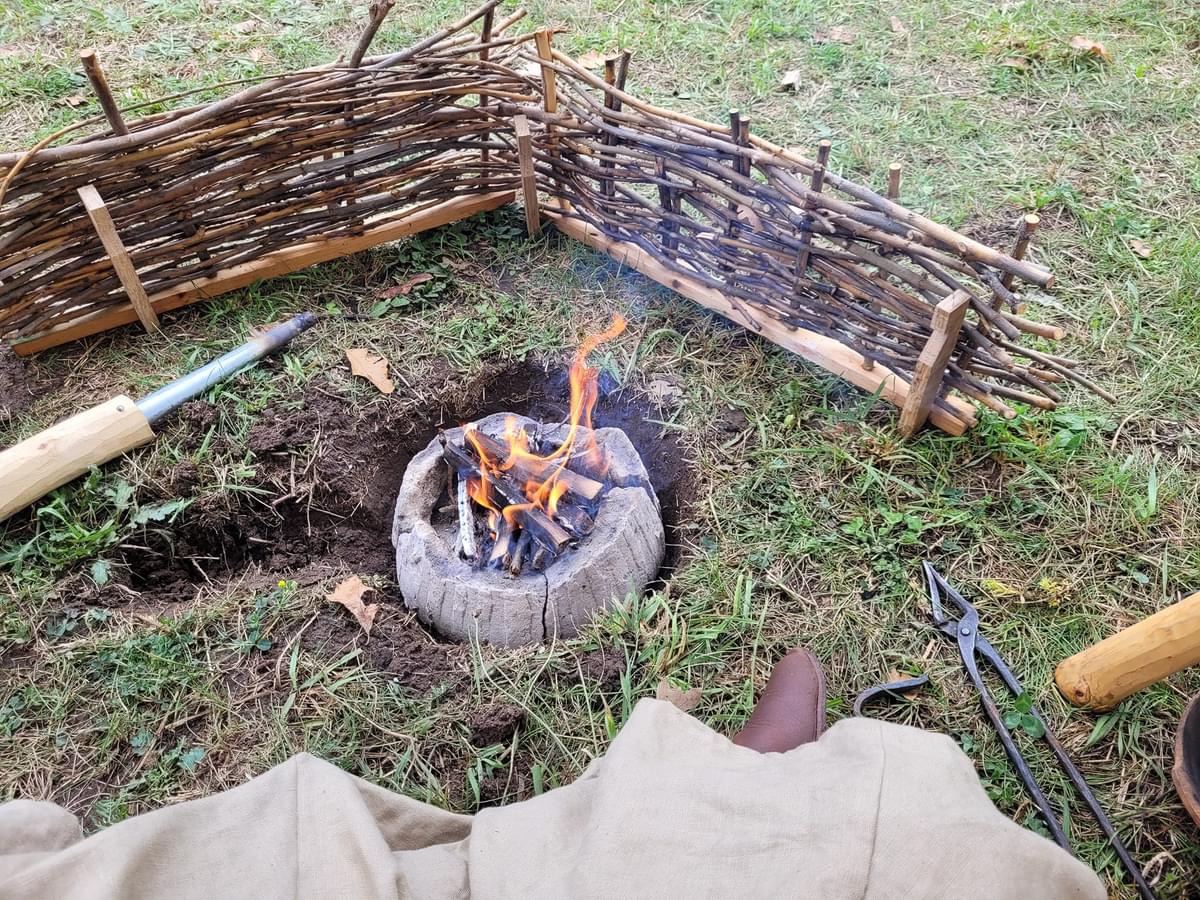
The missing front section was replaced with on hand stone blocks, setting a ceramic tube tuyere. The previously used basalt lintel stone was set above this to support the upper blocks. From the tuyere line upwards gaps between the blocks were sealed with fresh clay.

The completed replacement for the front section, now all stone blocks.

As much as possible, remaining pieces of the fused inner liner were patched together, gaps and cracks sealed with fresh clay. The clay used is the Icelandic clay analog mix, based on samples obtained by Michelle Hayure-Smith, and suggested by team member Marcus Burnam (see https://warehamforgeblog.blogspot.com/2021/06/sticking-to-it-clay-mix-for-icelandic.html) A very rough calculation was made of the clay required = about 2.5 litres (as a plastic mix).


Image into the interior, showing the lower rear and left side surfaces. Fresh clay is dark grey.

Two wooden sticks were driven down to help support the wall pieces as they were sealed in with fresh clay. It is expected there will be further cracking between the old and new surfaces as that applied clay dries and shrinks. There should be a second repair made to ensure new cracks are sealed before firing. This was a step not taken between the previous two uses, thought to be why there was a major burn through in that earlier front wall section repair.

A circle of stone blocks was added around the top of the opening to even off the shaft. These supported by additional cut sod. As currently set, the furnace has a roughly oval interior, about 30 cm front to back and 35 cm side to side. Total shaft height is irregular at 55 - 60 cm. The tuyere is set about 15 cm above the dirt base (which could be dug lower). This creates a shaft height of 40 - 45 cm.


G
M
T
Y
Text-to-speech function is limited to 200 characters

Friday, September 20, 2024

Æelfwyn Makes Enamel

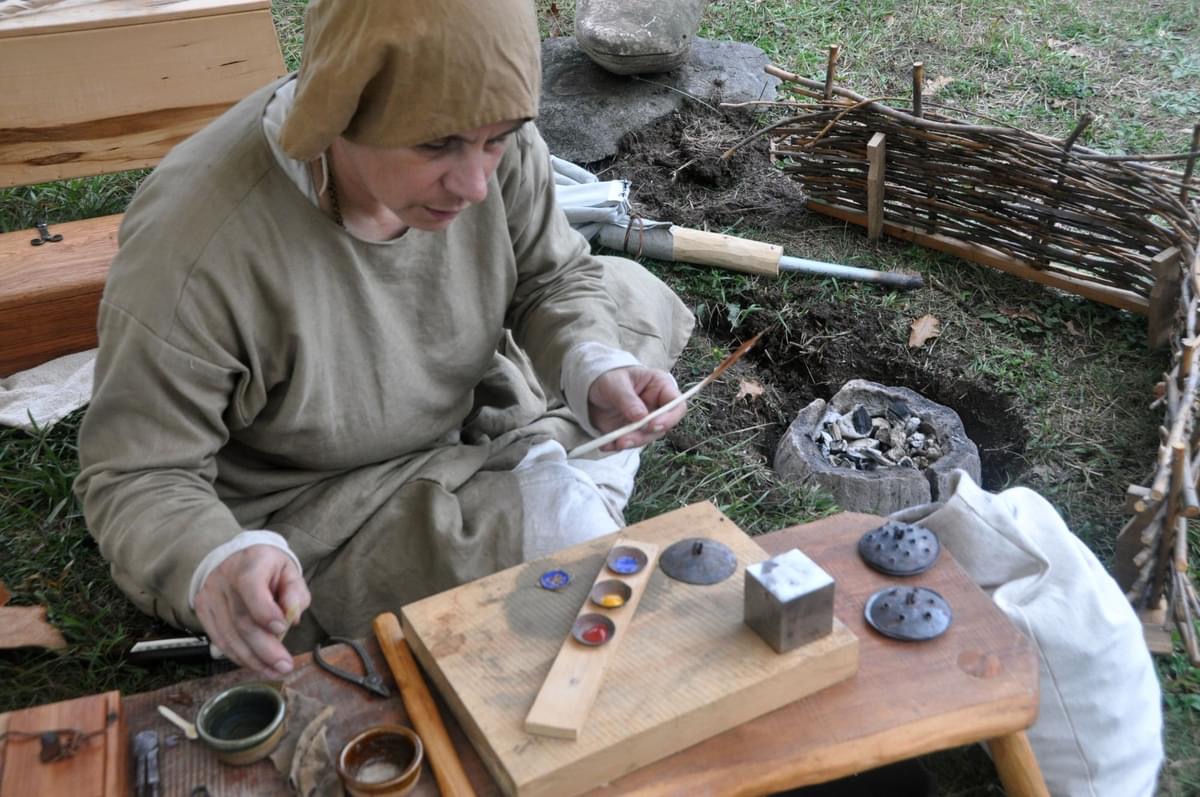
Æelfwyn’s starting point was this image of an Anglo-Saxon brooch.


This was her set-up.


And a couple of fun little videos showing her using the bag bellows and then putting a (different) piece into the fire.


Almost done!


The finished piece once it has cooled.

Æelfwyn said she was having trouble with temperature control, hence the bubbles .  The primary experiment was using Theophilus' technique of gluing the wires down with wheat paste, firing it, then adding the enamel.  He used it for soldering gold wire, but it worked fine for enamel.

Sunday, September 8, 2024

Stew

 One of our favourite things to do as a group is eat. This was a stew with onions, beets, parsnips, carrots, lamb and herbs, made in the replica Mastermyr pot that Kettil made.


Here’s what the original looked like:


 It was was 26 cm wide x 13.8 cm tall (handle not shown), found in Mastermyr, Gotland Sweden, and dated to circa 1150*. Source: The Mastermyr Find / Arwidsson & Berg, page 11, 29 - plate 11 / number 19d,

Wednesday, September 4, 2024

Weaving with an Oseberg-Style Loom

The Oseberg Ship was a rich burial from somewhere between 800 and 834, discovered in the early 1900s in Norway. It is now on display at the Viking Ship Museum in Oslo. Two women were buried in the ship, along with many textile-related items. Among the finds were parts of a loom, tablets, and a tablet-woven band. 

The loom, tablets and band as found in the ship grave.


It 
How the loom would have looked, from the archaeological report (Oseberg Fundet, Vol. II). 

The original was approximately one metre high and two metres long.

Hrobjartr, who normally does our tablet weaving, is unable to work due to a broken arm. We wish him a full recovery before he gets replaced by young Fion, shown here making the band found at Oseberg on a reproduction loom.

Tuesday, September 3, 2024

Our Camp at “Ribe” is Closed for the Season

DARC had a new place to set up camp for this year’s Labour Day long weekend so we imagined coming to the Viking-Age commercial centre of Ribe (in what is now Denmark) as traders and artisans. Trading was a seasonal activity, but people would come for several months each year. This allowed us to have a “camp” but also produce things rather than just “sell”.  

Ragnar and Kettil ran the bead furnace with the assistance of Fion on the bellows, and visitors were invited to try their hand at making a bead. The furnace broke part-way through thanks to a gust of wind that knocked a pole into it, but they were able to mend it and continue. There were also issues with the charcoal, but once they switched to a different charcoal they did manage to produce a few beads.

Thorgeir turned bowls on his pole lathe.


Jhone worked on her warp-weighted loom when she wasn’t cooking, and several visitors had fun weaving under her supervision. Herr she is chatting with Kadin, who is also a skilled textile worker.


Ælfwyn spent the day making enamelled items.

Auðr mostly puttered around the hearth, making butter, fixing some kitchen tools to be more useful, and making a new wooden spatula.


We have some ideas on how to make our “street” more accessible to visitors while retaining the model of workshops in front of sleeping areas, but overall we were pleased with how it worked.

Monday, September 2, 2024

Nålbinding

It was chilly last night so Kaðlin was wise to spend much of the last two days making herself a new nålbound cap using wool she had dyed and spun herself. She is using a simple loop stitch. The pink comes from madder while the blue is indigo over dyed with weld. While indigo was not found in the Viking Norse areas, chemically it is the same as weld, which was.


Sunday, September 1, 2024

Iron

Today I happened to sit through a class on iron by Kettil (Darrell Markewitz).

He talked about sources of iron, the basic processes to extract ore and turn it into iron, softer (easier to work), vs hard (holds an edge but brittle) and how both would be incorporated into things like knives or axes.

He also talked about the quality of iron produced and showed objects to demonstrate how it was used.

The most striking figure for me (Auðr) was the average amount of iron per person in a household: 2 kg. What that meant was you would have a personal knife but not much more. A ship needed around 2000 nails. Your household would likely have an axe, maybe some metal-edged farming implements, a cooking pot, and possibly  a bit more stuff like a cauldron hangar, pan or fork, depending on the size of the household. Things like fry pans and forks may have had wooden handles. A shovel would be wood with just a metal edge on the digging part.


Darrell has literally tons of experience making iron. 
2,500 kg of ore used
Just under 5,000 kg of charcoal
81 blooms totalling over 475 kg of iron
72 furnaces (some of which were reused for more than one smelt)
95 smelts
36 different kinds of ore
20 different kinds of furnaces to explore different styles and techniques based archeological remains
16 different kinds of air sources

He has a book coming out later this year to document his 25 years of historical iron smelting and what we expect to be over 100 smelts by the time of publication. Until then, you might be interested in one of his other books:
 

DARC is getting more active on social media

 Dear readers,

We had a hard time moving from the first millennium CE to the modern world: futhark to megBytes.

We’re on Threads and Instagram as @dark_ages_recreation_company.

You can also find us on Bluesky as https://bsky.app/profile/darc-company.bsky.social

And we’re on Facebook at The Norse Company 

Thorgeir in an intense conversation over preparations for a living history presentation.

Sunday, February 17, 2019

DARC at Upper Canada Village : 2018

These images are just some of the ones made by Kelly Probyn-Smith, at DARC's 2018 presentation at Upper Canada Village Medieval Festival.

From the rear of Camp : Beadmaking & Foodways
Rear section of Camp : Foodways / Carving / Woodworking
Beadmaking
Cordwork with tent interior
Foodways
Treadle Lathe
Warp Weighted Loom
Metalworking
Story Telling / Music with tent interior
Woodworking / Carving
Spinning with tent interior

These images were selected (by me) from a very large number (about 200) as ones that best illustrated the primary activities demonstrated in our presentation.  Also chosen with an eye to showing interaction with the public. (Also attempting have at least fairly good images of the individual members themselves - not always easy to achieve all three factors!)

The reason for undertaking this is that this year UCV is requiring all involved to submit a formal 'Request for Quotes' document. This includes images showing the overall camp, individual demonstrations and public involvement. This is likely more a formality than a competition in the case of DARC. There simply is no other Viking Age re-creation group in Canada with our depth of presentation experience and individual research.

Tuesday, September 11, 2018

Come to CAMELOT

http://dragenlab.ca/camelot-conference/

A number of people who are involved in DARC's experimental archaeology projects will be delivering sessions at the conference (marked with bold type below)

Darrell will be undertaking a full demonstration bloomery iron smelt as part of the 'outreach' side of this coming weekend's new CAMELOT conference:
The building a 'norse short shaft' furnace on FRIDAY.
The full smelting process will be undertaken SUNDAY, with extraction of the bloom intended for roughly the end of the day's sessions (about 5 pm +).

There will be some limited opportunities for conference members to directly participate. Those hoping to become involved should come dressed in 'work clothes' (must be all natural fibre, leather boots). Other safety gear will be provided.

This marks the first time this experimental archaeology process has been demonstrated at an academic conference in Canada.


CAMELOT is the continuation of the long running 'Forward Into the Past' event.
For it's initial year, registration for the conference is FREE (via their web site).

The core of the conference is a full series of academic type paper presentations, by senior students, independent researchers, and academics. This allows for topics of interest to a wide range of people, from the general public through to the professional.

This is the published outline of sessions :


CAMELOT
Preliminary Conference Schedule
Session 1: Military
9:00 - 10:30
·       Damien Cole – The fyrd: Anglo-Saxon military organisation, recruitment, and the                                         deployment of different types of units on the ancient English battlefield

·       Daniel Hutter – The Varangian Guard
·       Ben Hennin - influences of Homeric/Roman Epic poetry on the medieval Song of Roland
Session 2: Archaeology
10:45 – 12:15
·       Andrew Moore - Archaeology and the Hill Figures of England: Ancient Giants or Early                                                                     Modern Satire?

·       Rachel Cogswell – Exploring Non-Ferrous Metalworking in Sweden, 500 – 798 CE
·       David Miles – The art of smithing: social perspectives of practitioners in the Middle Ages
Session 3: Travel
10:45 – 12:15
·       Daphne Van Delst –Medieval Badges
·       Augustine Dickinson – Ethiopian manuscripts: importance and analyzation
·       Alexander Bucholtz – King Sigurd I of Norway: Scandinavian participation in Iberian and Middle Eastern crusading
Session 4: Demonstrations
1:30 - 2:15
·       Wendy Maurice – How I grew a Tunic
·       Jean Ross – The Making of a Treasure Necklace based upon the Hon Hoard
·       Colleen Moynham – Brass Rubbing
Session 5: A Medieval Miscellany
2:30 – 4:00
·       David Porecca - Picatrix: A Medieval Grimoire of Astral Magic
·       Neil Peterson - The Big Burn: Report on a pilot bead furnace
·       Andrei Tudor – Ancient Thracian deities and Greek/Roman deities: a comparative study

   HOPE TO SEE YOU THERE!


Sunday, July 1, 2018

'the Viking Warrior' - book review


the Viking Warrior - the Norse Raiders Who Terrorized Medieval Europe

Ben Hubbard
Amber Books - 2015
978-1-78274-291-3

I had picked this up at my last International Congress for Medieval Studies conference (2016). Honestly, the book seller had it for a very good price (think it was about $25 US) and I really only gave it a casual glance when I picked it up, part of a larger purchase.
With the recent publication date (yes, I had checked that), I had hopes for some current information.
But honestly - the second line of the title should have warned me.

Although richly illustrated (the back jacket states 'Includes more than 200 artworks, photographs and maps'), it is the source of those illustrations that becomes, frankly, annoying rather than reveilling. 'Artworks' dominate. Those illustrations are primarily Victorian era, with all the fantasy elements and distortions you would expect. Yes, there is often mention in the captions included of the major errors pictured. My guess is that these images have been selected not for clarity, but simply that, because their age, the images fall outside copyright provisions.
Many of the actual photographs in the volume are images of amature Re-Encactors, or their equipment. Obviously the quality of these re-creations can vary widely. (I really don't see how an image of modern plywood shields best illustrates actual Viking Age objects?) In some cases, the images chosen don't actually represent historic object types at all. There are some artifact images (maybe 1 in 10), but those will be well familar to even the casual observer of the Norse (mainly included from widely available 'open source' collections).
A clear key here is a check to the 'picture credits' as listed. These are almost internet based image collection services. Only a handful are from actual museum sources.

Of the 224 pages, the first third (90 pages) cover 'Viking Origins' and 'Viking Society'. It would be most accurate to say the topics are at best superficial. In a number of cases I found statements either vague, misleading - or just plain incorrect.
The bulk of the book is primarily a brief summary of the major conflict and political developments involving the Scandinavians from the first documented raids in the last years of the 700's through to the 1066 invasions in England.
The book does make consistent reference to both Saga documents and historic contemporary accounts. The pattern here however starts to look a lot more like an attempt to build credibility through the quoting of historic sources - instead of depth of recent research. The bibliography lists primarily popular level works, the volumes most of us have long had in our own libraries.

In total, I would suggest that 'the Viking Warrior' was a fast turn over work, created to cash in on recent pop culture interest in Vikings (largely generated by the recent TV series on the History Channel - with all its own massive flaws!)  At best this book is a superficial treatment of the topic. It might have proved suitable for a high school level introduction, save for the dominance of extremely dated, usually inaccurate Victorian illustrations.

Overall my recommendation would be to save the money, and put the amount towards purchase of perhaps 'the Viking World' by Graham-Campbell'.


Tuesday, January 9, 2018

Podcasts - An Update

Almost a year ago I posted about podcasts relating to vikings and archaeology. Time for an update!

Sagathing https://sagathingpodcast.wordpress.com/

If you aren't already a fan... go there now, download an episode and put it on in the background while you finish reading this blog. Go on.

Sagathing is two medieval history profs out of the US (John and Andy). They are working their way through the family sagas. Episodes run 60 to 90 minutes. Usually 1-2 episodes per saga although they took a dozen to deal with Njal's Saga. Each saga is summarized and discussed, then judged on a number of criteria including 'best bloodshed' and 'best nickname'. The interaction between the two podcasters is quite enjoyable. While I'm sure they have a plan for a given episode I doubt there is a script. The conversation really makes this a very enjoyable podcast although I miss the ability to talk back to them. I look forward to each new episode.

Viking Age http://vikingagepodcast.com/

This podcast has undergone some shifts over the past year. This is one host and it very much comes across as a recorded, scripted lecture. It makes it easy to drift off while he is talking. The content is reasonable enough and I expect to learn some things as we move forward. The podcast begins with the settlement of Scandinavia back before 10000 BCE. The first half dozen episodes (a half hour each give or take) move through the various time periods up to an including the iron age. Once he got into the viking age he split off looking at vikings in different countries. This includes backstories like episode 23-27 where he covered the Carolingians. Around episode 32 he got a bit bored and changed things mixing in telling stories of characters like Harold finehair. The main thread over the last few months has been a look at the viking culture itself (law, chieftainships, etc). The Viking History itself hasn't shown up at all lately. Has has stayed with his single voice lecture style. I keep listening, and picking up tidbits, but I'd love to hear the same topics covered in more the style of sagathing.

Norse by Northwest http://www.norsenorthwest.com/

An interesting podcast. Again a single person speaking but the Scottish accent and delivery style on this fellow make it a more enjoyable listen than the Viking Age Podcast. Very infrequent releases (last one was in Sept) and only 7 episodes so far.

Sadly those represent all the Viking podcasts for which I listened to more than one episode. Does anyone have any other ones that they recommend?

Now on to Archaeology Podcasts

Archaeology Podcast Network https://www.archaeologypodcastnetwork.com/

APN is absolutely the right place to begin discussing archaeology podcasts. The Archaeology Podcast Network hosts 17 archaeology focused podcasts. I have become a regular listener to several of them. I'm not going to list all of them - just the ones I actually listen to. By all means though please drop by their main page and have a look at all of their offerings. The APN is the brainchild of Chris Webster and he is all through it. Most podcasts have their own hosts talking about topics that interest them, but Chris also hosts several podcasts.

Archaeotech https://www.archaeologypodcastnetwork.com/archaeotech

This podcast has a pair of hosts early on it was two Chris' but now it is Chris and Paul. Some episodes bring in guests others are just the two of them. Recent podcasts have included drones, VR, and 3D printing. Episodes run around an hour every other week and the conversation tends to be fun and interactive. A good way to keep up on changing technology in archaeology.

Arch365 https://www.archaeologypodcastnetwork.com/arch365/

A daily podcast now moving into its second year. Episodes average around 5 minutes and are just a very brief introduction to topics of interest. That can include specific sites (recently they covered L'Anse aux Meadows for example), but it can also be technologies (a sequence last year covered GPR, Resistivity, etc). A nice fast way to keep a little archaeological learning in your days.

Archaeological Fantasies https://www.archaeologypodcastnetwork.com/archyfantasies/

For those who enjoy a good debunking or discussion of the 'mysterious' in archaeology this is your podcast. Like many APN podcasts this is an hour every couple of weeks. Recent episodes included the Dighton Rock, Djinn, and Haunted Objects. Drifts between 2 and 3 hosts sometimes with guests. Definitely suffers from "remote podcast" problems. Serra is clearly on the console (good audio) but her co-hosts regularly step on her talking and guests can suffer from that and audio quality problems. The content is a great deal of fun though and each host is worth listening too. The sarcasm can get thick.

The Archaeology Show https://www.archaeologypodcastnetwork.com/archaeology/

This one is all over the place with regards to topics: field schools, Ice Age Art, Museums, you name it. Again two hosts (April and Chris) usually an hour every couple of weeks. Fun to listen to - and always something to learn.

Archaeology and Ale https://www.archaeologypodcastnetwork.com/archandale/

This is definitely an odd one. This is a recording in the upstairs of a pub of lectures given near the University of Sheffield. Audio quality isn't the best as one might expect, and obviously you can't see the slides. Topics can be all over the place as you might expect. And production is irregular at best (last episode was in August). I listen in when the topics catch my eye.

Prehistories https://www.archaeologypodcastnetwork.com/prehistories/

Kim and guests usually discuss books of (prehistoric) interest. Honestly I wasn't sure about this one but I am finding it rather enjoyable. Again as one would expect it is all over the place. The most recent episode discussed Sutcliffe's fictional "Warrior Scarlet" (1958), but two episodes earlier she and some guests were spending the evening in an iron age hill fort talking about stories they enjoy and public archaeology. Call this one a monthly one-hour podcast even if the idea of "month" isn't overly regular.

Moving off the APN there is:

Audio News from Archaeologica https://www.archaeologychannel.org/audio-guide/audio-news

Running about 10 minutes and coming out weekly this one covers 4 news stories about archaeology from the previous week. A good short "news report" - usually there are a couple of things that I enjoyed hearing about in each broadcast.

Indiana Jones: Myth, Reality, and 21st Century Archaeology https://www.voiceamerica.com/episode/97394/catastrophe-and-collapse-the-mediterranean-world-in-the-late-bronze-age

Like Viking Age this is a single speaker but all of the episodes I have heard have been him interviewing different people. He isn't the best interviewer I've heard and the interactions come off very stilted. I have been cherry-picking episodes as I find ones where the topic grabs my interest. Very focused on the US archaeology industry. This one may be dead as the last episode posted is from April.

Finally I am also listening to Medieval History for fun and Profit http://www.on-soap.com/medieval-history-for-fun-and-profit/

Dr. Alice R. and Dr. Alice T. of King's college London take turns being the "host" and "guest" as they answer questions about medieval history. Sex, Pets, Magic, Who is the best Medieval Person - they have certainly done some fun questions. Episodes come out every 2-3 weeks and run about an hour. Well worth a listen.

Alright - your turn. What archaeology or Viking Era podcasts do you listen to and what do you think of them?

Thursday, October 19, 2017

Wareham Forge makes the News...

... as in 'ThorNews'
https://thornews.com/

ThorNews describes itself as 'a supplier of Norwegian Culture' - with a very heavy load of Viking Age topics represented.

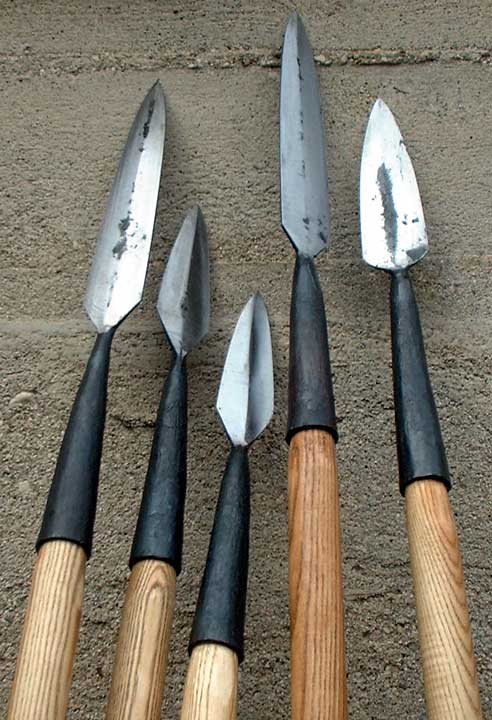
Author Thor Lanesskog had chosen to use an image of a group of replica spears I had made to help illustrate today's blog post :

The Viking Age Spears – “The Ones Who Stare from a Long Distance”

on


" The majority of the spears are decorated with fish bone patterns, pattern forged along the middle of the blade " 

I sent back a bit of a clarification :

The 'forged pattern' is the result of welding layers of soft and hard iron metals together, then twisting and welding again, most typically to form the core part of a blade. There are some (unresolved) questions about why this method, called 'pattern welding' in archaeology, was undertaken originally. It can provide functional advantages, especially for long blades (so with swords). It may be as simple as building up a larger block when all the smith had were small pieces. The techniques were also clearly used for their decorative effects. Spears using pattern welding a very good example.
'Wolf's Tooth' actually refers to a specific effect caused by a specific method of working with the starting layered bars. I would refer you to the work of British blacksmith Owen Bush, who I know has investigated how to duplicate those specific patterns. 


Tuesday, October 17, 2017

DARC at Vinland - seen on ExARC!


https://exarc.net/issue-2017-4/mm/dark-ages-recreation-company-lanse-aux-meadows-nhsc-2017

Neil Peterson, with additions from DARC members Marcus, Kate and Karen, has had a very complete summary of the group's July 2107 presentation at L'Anse aux Meadows NHSC published in the journal ExARC.


Abstract:
To celebrate Canada’s 150th anniversary and the 20th anniversary of the historical interpretation program at L’Anse aux Meadows, NHSC, Parks Canada invested to extend their regular staff with a 10 day special program. Darrell Markewitz, the designer of the original program, and the Dark Ages Recreation Company (DARC) returned once again to this UNESCO World Heritage site to interact with the staff and public and mount displays of various craft activities.

The article details the public presentations and experimental archaeology projects carried out over the 11 day stay by a total of 14 DARC members.
Mounting such a major display, 3000 km from home base in Ontario, represents a major effort for DARC.

Next up for the group? 


Participating in the Royal Ontario Museum's presentation of 'Vikings' - a traveling exhibit from the Swedish History Museum

Monday, October 9, 2017

Review: Making glass beads from the past

Making glass beads from the past

EuroREA 7 (2010) Jannika GRIMBE https://exarc.net/files/exarc-eurorea_7_2010-making_glass_beads_from_the_past.pdf
This is a nice little (4 page) article on Jannika's experimental bead making. The first page covers the usual archaeological evidence and background on Viking Era beadmaking. There are a lot of assumptions being made, and statements for which I would love to see citations. For example, the metal plate from Ribe is presented conclusively as a pre-heating plate for glass fragments before adding them to a punty rod. While that is one possible idea there are other suggestions for that plate that have been made over the years. Her final bullet point in the archaeological section mentioned that "Analyses of 'non-glass' rests in the bead holes of beads from Ribe prove the use of separators". Statements like that really do require citations. On the plus side, a citation does appear on page three when the point is repeated.

The second page begins with a discussion of the furnaces. Sadly, she begins her discussion with "Since there is no knowledge about what the prehistoric furnaces looked like". This is simply false. The hearths from Ribe have published shapes and dimensions. Any effort to re-create the furnaces must begin with an understanding of that basic fact. If your furnace design is going to deviate from those bases you need to explain why you chose to do so.

The practical experiments were quite interesting as she worked heavily with punty rods. This isn't something we have done a lot of work with ourselves but is certainly a reasonable area to explore. I am happy to see someone exploring it. A method she did not try for working with a punty rod, which we have done, and is done today by Turkish beadmakers is to use a crucible to collect and melt the fragments. The rod can then be inserted into the crucible and the glass collected on it for future use. See for example https://www.youtube.com/watch?v=0G5EMXekreM. The experimental sequence involving resists ("rests" according to the article),  is very much worth the read. Some good basic options of clay and salt are tested and discussed. Overall a good experimental summary.

Saturday, August 19, 2017

the Galloway Hord...


At the National Museum of Scotland - Edenburgh :


Lower groupping of arm 'rings'

Upper grouping of ingots and worked strips

Revealed in the two cases above :
- Several of the ingots were clearly made in the same top poured mould. There was a distinctive knob feature seen, from a deeper cut to one end of the mould.
- The arm rings were all considerably thicker in cross section than I previously thought. (Exact L x W x H x weight is rarely indicated.)
- Seeing the ingots and the arm rings side by side certainly suggested that the arm rings were made by simply hammering flat the ingots. The sizes of the bracelets was very uniform, and the volume of metal from ingot into ring was very consistent.
- You also can see that all of the 'rings' are in fact flattened strips - not formed into C shapes at all.
This might easily have been done to keep the package of silver small for burial. That many of the bracelets have been deliberately turned over and squished flat on one or both does suggest that all the silver, worked or ingot, was only intended as silver weight.

Pair of fine silver hinged strap orniments - considered very unusual for VA finds

These large glass pieces were described as 'beads'
The large flattened disks were roughly 3 - 4 cm in diameter, with hole diameters approaching 1 cm.
The largest, to the lower right, was almost double even that mass of glass.
Taken together, this huge size suggests to me that these might easily have been intended as spindle whorls.

Not everything from the Hord was on display. Especially most of the more 'unusual' objects (likely still under preservation work).
For more images - go to the Galloway Hord at the NMS


We have to raise £1.98 million to save the Hoard, and in addition we need  to raise additional funds to properly conserve, research and prepare the Galloway Hoard for display, (NMS web site)
 The Hoard was uncovered by a single individual, so it would fall under Scottish 'Treasure Trove' law. It appears that although technically all  such finds revert 'ownership' to the Scottish Crown, in practice, an independant pannel determines a 'market value', which museums normally pay to the original finder.


Images :
The National Museum of Scotland allows for full photography in all its galleries.
All the images above were taken by myself on August 9, 2017
Although captured as photographs, the copyright to the text panels really rests with the NMS.

Cross Posted from 'Hammered Out Bits'