



This was my third visit to LAM, having previously gone as a tourist in 2006
and as part of the DARC team in 2010. I had already done most of my
"must-see" sightseeing, so this time I was quite content to spend every day
at the site with my friends from Newfoundland and Ontario. Once again, they
were the best part of my experience and I couldn't think of anything I
would rather do than play with them.
My "job" in DARC has evolved into one involving string. On the last visit,
I worked a bit on my fishing net but didn't get very far. It turned out
that the knot I was using slipped (just fine for lacemaking, where I
learned it, but less effective if you want sturdy nets to catch fish).
Ragnarr and Bjorn each taught me their preferred netting knot last time
out. I took great pleasure this time in stringing up the net, having
Ragnarr come over on the first day to inspect my work, and give me a big
smile because I was now doing it right. I was able to do a lot of work on
the net, including repairs to older sections where there were mistakes.
Making a fishing net is a very evocative activity in Newfoundland, where
many of the visitors come from fishing families. They enjoy sharing
memories of repairing nets or watching their dads do so. I love the
personal connection, and seeing how the site goes from being a museum to a
"real" place.
On the way back from LAM, we stopped at the Fortress of Louisbourg, where I
learned something about how to preserve my hemp net and fishing line with
pine pitch. I'll be experimenting, now that I have found a source of pine
pitch (my local tack shop). I also got ideas for other things made of rope,
such as ladders, monkey fists, and boat bumpers, and will be researching
evidence of their use in the Viking Age.
Most of my other string experiments this time were with slyng
(whipcording). I made some cord using two colours of wool I had dyed and
spun. Eventually, it will be used for straps or decorative trim.
I also used slyng to make a hemp bowstring with Jorunn. We started the
braid a few inches down our cords, then looped the top and spliced the
loose ends into the slyng. This gave a very sturdy loop for the top of the
bowstring. The bottom end was simply finished with a thin cord whipping,
and tied to the bow with a bowyer's knot (timber hitch). The bowstring was
round and just the right size for the arrow nocks, although it doesn't have
much spring. It was fun to contribute to the site by leaving an artefact
behind.
Based on the bowstring experience I have decided that my next attempt at a
horsehair fishing line will involve slyng. Historically, fishing lines were
often made of horsehair, which is both strong and long-lasting. I tried
various ways of making a fishing line while at LAM. There is evidence of
twisted horsehair fishing lines date from around the 1400's, and the short
sections of line were somehow knotted together. Remember, about 30 feet of
line is needed, and good horse tails are rarely much longer than about 25
inches. My first attempt with twisted line was a complete failure. The line
was just too slippery to be knotted or hold a splice. The next attempt,
joining short lines made from plain three-strand braids was equally
impossible. Since simple knots didn't work, I tried making a loop and
splicing the end bits into my braid. Although splicing a loop worked
somewhat better, spliced loops could only be used on one end of the line
(loosening the braid and stuffing the ends in didn't work) . I still needed
to knot the other end. Splicing a continuous braid might be a little
sturdier, but a slyng braid is much tighter than a three-strand braid, so
that's what I will be trying next.
The other thing that I enjoyed at LAM was doing the hair of my friends each
day. It wasn't exactly rope, but it did involve lots of braiding. I
experimented with different braids, found ways to disguise modern
hairstyles, and provided another connection point for visitors to relate
their daily lives to those of the Viking Age Norse.
Diane, aka Auðr
Sunday, October 28, 2012

Wednesday, October 10, 2012
"Bottle" Bead Furnace
For a number of reasons, Neil Peterson and I decided not to
mount an iron smelt over Thanksgiving weekend, but concentrated on the
VA glass bead making furnace research instead.
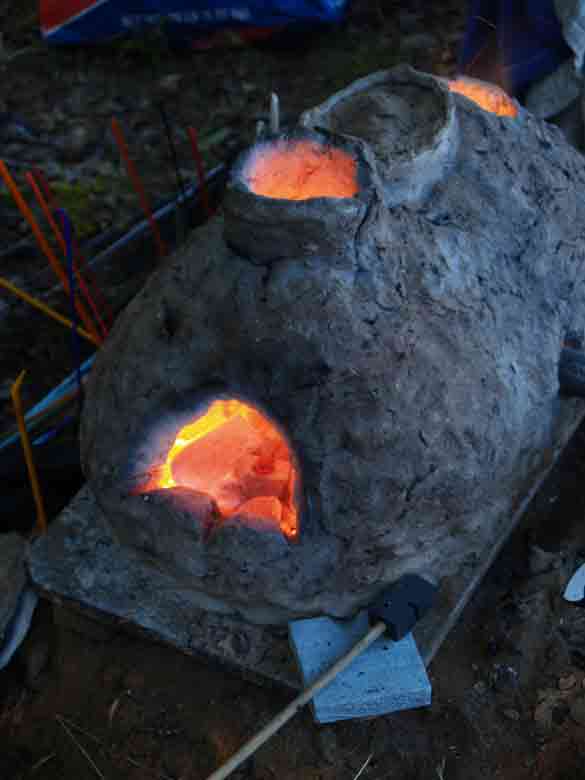
The initial experiments in this area were framed by the existing clay 'based plates' found at Ribe Denmark. It should be noted that although there is evidence of glass bead production at a couple of Norse trade / urban sites, there has not been a single complete furnace found. Experimental furnaces we have constructed using these artifact footprints have never been truly effective for actually making beads. There may be some other purpose for the clay slabs (?)
There were a number of continuing problems with the large oval furnaces, as suggested by the artifact bases :

1) Very short effective temperature cycles - in the range of 10 minutes
2) Side ports proved very difficult to work inside - limited space and heat onto hands
3) Top ports proved less than ideal - too large an area for effective control of glass
4) Continuing problems with ash coating surface of beads
5) Large internal volume required considerable charcoal expenditures to operate
6) The top ports were quite effected by any cross winds (operated outside)
Taking my experience with charcoal forge fires, and what we have learned from the much larger charcoal fired iron smelting furnaces, I had suggested this as a possible effective layout:


We tried out a couple of early versions of this system, back in 2009. These were abandoned, mainly because they do not conform to the known artifact 'bases'.
The concept here is that all the exhaust gasses are bottled up and forced out of a top vent hole, which in effect creates a working space much like a more modern torch flame.
Returning to this operating system, Neil constructed a new prototype, based some new observations and suggestions from me, back in mid September. This furnace had been air drying for several weeks. Sunday's workshop saw it fired and operated through several charging cycles:
There was no doubt that this new furnace was a massive improvement:
1) Effective operating cycle in the range of 75 minutes (!)
2) Higher working temperatures at the upper port
3) Narrow flame created more effective control of the glass itself
4) Ash greatly reduced (mostly absent)
5) Significantly lower charcoal consumption
6) 'Time per bead' rate greatly reduced
This all creates one of the classic problems in experimental archaeology : 'If you can't get the same results, you can't be doing the same thing they did' vs 'That certainly works - but it does not match the available artifact evidence'.
In the actual absence of any complete furnaces (or even upper fragments) from VA sites, my gut feeling is that the few surviving 'bases' may be from some other process entirely. Annealing pans is one possibility.
Our research and experimentation continues...
(duplicated from 'Hammered Out Bits')
The initial experiments in this area were framed by the existing clay 'based plates' found at Ribe Denmark. It should be noted that although there is evidence of glass bead production at a couple of Norse trade / urban sites, there has not been a single complete furnace found. Experimental furnaces we have constructed using these artifact footprints have never been truly effective for actually making beads. There may be some other purpose for the clay slabs (?)
There were a number of continuing problems with the large oval furnaces, as suggested by the artifact bases :
1) Very short effective temperature cycles - in the range of 10 minutes
2) Side ports proved very difficult to work inside - limited space and heat onto hands
3) Top ports proved less than ideal - too large an area for effective control of glass
4) Continuing problems with ash coating surface of beads
5) Large internal volume required considerable charcoal expenditures to operate
6) The top ports were quite effected by any cross winds (operated outside)
Taking my experience with charcoal forge fires, and what we have learned from the much larger charcoal fired iron smelting furnaces, I had suggested this as a possible effective layout:
We tried out a couple of early versions of this system, back in 2009. These were abandoned, mainly because they do not conform to the known artifact 'bases'.
The concept here is that all the exhaust gasses are bottled up and forced out of a top vent hole, which in effect creates a working space much like a more modern torch flame.
Returning to this operating system, Neil constructed a new prototype, based some new observations and suggestions from me, back in mid September. This furnace had been air drying for several weeks. Sunday's workshop saw it fired and operated through several charging cycles:
 |
| Layout of the Furnace : about 30 cm OD. Annealing pot to left. |
 |
| Lid removed, filling with charcoal. Electric blower used for this test series. |
 |
| Fresh charcoal vents off combustible gasses for about 5 minutes. |
 |
| Stable working flame, working a simple glass bead in the 'stack' |
 |
| End of a working cycle, charcoal has burned away from centre to base. |
1) Effective operating cycle in the range of 75 minutes (!)
2) Higher working temperatures at the upper port
3) Narrow flame created more effective control of the glass itself
4) Ash greatly reduced (mostly absent)
5) Significantly lower charcoal consumption
6) 'Time per bead' rate greatly reduced
This all creates one of the classic problems in experimental archaeology : 'If you can't get the same results, you can't be doing the same thing they did' vs 'That certainly works - but it does not match the available artifact evidence'.
In the actual absence of any complete furnaces (or even upper fragments) from VA sites, my gut feeling is that the few surviving 'bases' may be from some other process entirely. Annealing pans is one possibility.
Our research and experimentation continues...
(duplicated from 'Hammered Out Bits')
Friday, October 5, 2012
Bead Furnace at Bonfield
(Cross posted from Hammered Out Bits )
These images are all by Vandy Simpson, taken at the Bonfield Battle event run each Labour Day by my old friend Steve Muhlberger.
As a continuation of the ongoing experimental research under Neil Peterson, DARC mounted a combination demonstration and hands on session with a possible Viking Age bead working furnace. The furnaces are clay & horse manure construction, fire charcoal, and are based on 'possible' footprints suggested by the archaeology primarily from Ribe Denmark. For a more complete background, see Neil's published research.
Two primary problems are plaguing us with this specific design, which is based on the size of one of the uncovered 'base plates' :
1) Although high enough temperatures can be produced to effectively work the glass, the actual effective time is quite short. Our skill levels are mid level at best, and typically only one semi complex (base plus two colour patterning) can be created in one charcoal fill cycle.
2) Marred surfaces, from flying ash and small particles of burning charcoal are common, almost universal. Artifact beads do not show these effects as common. This strongly suggests we are doing something 'wrong'.
Our next prototype furnace is abandoning the profiles suggested by the artifact bases. Instead I have suggested a design based more on the dynamics of burning charcoal, gathered from experience working with charcoal forges. The concept is to contain the hot gasses to produce an effect more like a torch - then work inside that blast. (An earlier post describes this system.)
There will be a workshop this weekend at Wareham where a few of us will be working with a new prototype. Hopefully there will be a field report with some images later in the week describing the results...
These images are all by Vandy Simpson, taken at the Bonfield Battle event run each Labour Day by my old friend Steve Muhlberger.
As a continuation of the ongoing experimental research under Neil Peterson, DARC mounted a combination demonstration and hands on session with a possible Viking Age bead working furnace. The furnaces are clay & horse manure construction, fire charcoal, and are based on 'possible' footprints suggested by the archaeology primarily from Ribe Denmark. For a more complete background, see Neil's published research.
 |
| Overall view of the set up - inside the 'forge' duggout area |
 |
| Working in the stack, heating new rod to apply decoration |
 |
| Streaks are small pieces of burning charcoal in the vent |
Two primary problems are plaguing us with this specific design, which is based on the size of one of the uncovered 'base plates' :
1) Although high enough temperatures can be produced to effectively work the glass, the actual effective time is quite short. Our skill levels are mid level at best, and typically only one semi complex (base plus two colour patterning) can be created in one charcoal fill cycle.
2) Marred surfaces, from flying ash and small particles of burning charcoal are common, almost universal. Artifact beads do not show these effects as common. This strongly suggests we are doing something 'wrong'.
Our next prototype furnace is abandoning the profiles suggested by the artifact bases. Instead I have suggested a design based more on the dynamics of burning charcoal, gathered from experience working with charcoal forges. The concept is to contain the hot gasses to produce an effect more like a torch - then work inside that blast. (An earlier post describes this system.)
There will be a workshop this weekend at Wareham where a few of us will be working with a new prototype. Hopefully there will be a field report with some images later in the week describing the results...
Friday, September 28, 2012
Memories of LAM 2012 - Rob and Keiran
Memories of LAM 2012
This year's trip out to L'ans aux Meadows was very different from the first time. I knew what to expect this time and, best of all, I had my family with me. While the children didn't have quite the enthusiasm to work on all of the projects we had planned, I enjoyed having Keiran there to help me wind balls of thread and watching him play tafl and nine-man's-morris with the others.
For myself, I reaffirmed that you can never get projects completed when interacting with the public. My bow got to the point where I could draw it, but it still needs more work to be functional. The knotwork band I was tablet weaving involved frequent repair of errors and ever more frustrating repairs to broken warp threads. Yet it is the interaction with the public that I enjoy most. You never know who will be fascinated by the work, what sort of questions they will ask, or what information they can provide.
Other memories include:
- Having a viking girl guide show up on our steps one day to sell us cookies. (My brother actually saved them for the trip home - and ate one in each province.)
- Hiking along many beautiful trails (the best being the roller coaster of an abandoned boardwalk)
- Being chased off by some caribou who became tired of having their picture taken
- Spending time in and out of personae with my friends from near and afar
- taunting Ragnar and Thora with wasabi peanuts and odd flavoured chips
- munchkin chthulu
- holding a Thing in the ocean
- heckling Ragnar soft-hands with lots of assistance from Kadja and many others
- and of course just spending time in a place that just feels right - the spring of the soil beneath your shoes, the smell of the ocean winds, and the serenity of leaning against a cool earthen wall
Rob/Hrobjartr
Rob's son - Keiran's trip to L'ans aux Meadows aka memories of a 6 year old viking
I remember:
• weaving with daddy
• being a viking
• playing games - tafl, 9 man morris,
• cold weather
• playing games with friends - viking friends
• eating the flat bread
• the helmet, sword and shield in the longhouse
favourite parts
• weaving
• helping people out - showing people around and telling them that they were allowed in the buildings
• being with Liam (his cousin)
This year's trip out to L'ans aux Meadows was very different from the first time. I knew what to expect this time and, best of all, I had my family with me. While the children didn't have quite the enthusiasm to work on all of the projects we had planned, I enjoyed having Keiran there to help me wind balls of thread and watching him play tafl and nine-man's-morris with the others.
For myself, I reaffirmed that you can never get projects completed when interacting with the public. My bow got to the point where I could draw it, but it still needs more work to be functional. The knotwork band I was tablet weaving involved frequent repair of errors and ever more frustrating repairs to broken warp threads. Yet it is the interaction with the public that I enjoy most. You never know who will be fascinated by the work, what sort of questions they will ask, or what information they can provide.
Other memories include:
- Having a viking girl guide show up on our steps one day to sell us cookies. (My brother actually saved them for the trip home - and ate one in each province.)
- Hiking along many beautiful trails (the best being the roller coaster of an abandoned boardwalk)
- Being chased off by some caribou who became tired of having their picture taken
- Spending time in and out of personae with my friends from near and afar
- taunting Ragnar and Thora with wasabi peanuts and odd flavoured chips
- munchkin chthulu
- holding a Thing in the ocean
- heckling Ragnar soft-hands with lots of assistance from Kadja and many others
- and of course just spending time in a place that just feels right - the spring of the soil beneath your shoes, the smell of the ocean winds, and the serenity of leaning against a cool earthen wall
Rob/Hrobjartr
Rob's son - Keiran's trip to L'ans aux Meadows aka memories of a 6 year old viking
I remember:
• weaving with daddy
• being a viking
• playing games - tafl, 9 man morris,
• cold weather
• playing games with friends - viking friends
• eating the flat bread
• the helmet, sword and shield in the longhouse
favourite parts
• weaving
• helping people out - showing people around and telling them that they were allowed in the buildings
• being with Liam (his cousin)
Tuesday, September 25, 2012
Presenting Experiments
Darrell and Neil are headed out to the Reconstructive and Experimental Archaeology Conference in North Carolina the weekend of Oct 18th.
Saturday will see two presentations:
Early Iron in North America
Since the late 1990's there has been increasing interest in the direct reduction bloomery process in both Europe and North America. The 'Early Iron' movement in North America is driven not by archaeologists, but by working blacksmiths. In this way, practical metalworking experience has been brought to bear on what is largely unknown technical processes. Although the focus is on iron production, there are clear links to the first iron smelting furnaces built historically on this continent. This presentation will focus on some of the discoveries made and lessons learned over hundreds of iron smelts by a core group of experimenters.
Sunday will hopefully see two practical sessions
The Aristotle Furnace
Saturday will see two presentations:
Glass on Fire: A review of 5 years of experiments in the reproduction
of Viking Era Glass Bead Furnaces
Glass beads were a widely used form of Viking era Norse personal
ornamentation. Seven production sites have been found archaeologically,
although only Ribe has well-documented traces of furnaces. Using data from the
excavations, and experimental archaeology, various possible charcoal fired clay
cob furnace reconstructions were constructed and tested. The as yet unrealized
goal is to produce a furnace that matches the archaeological remains and is
capable of producing beads that match the artifact samples. This paper reviews
the archaeological material and the experimental sequences undertaken over the
last five years. Early Iron in North America
Since the late 1990's there has been increasing interest in the direct reduction bloomery process in both Europe and North America. The 'Early Iron' movement in North America is driven not by archaeologists, but by working blacksmiths. In this way, practical metalworking experience has been brought to bear on what is largely unknown technical processes. Although the focus is on iron production, there are clear links to the first iron smelting furnaces built historically on this continent. This presentation will focus on some of the discoveries made and lessons learned over hundreds of iron smelts by a core group of experimenters.
Sunday will hopefully see two practical sessions
The Aristotle Furnace
Working from clues by Aristotle and the
descriptions of Ole Evanstad, combined with practical insights from a
decade of bloomery iron smelting, a small re-melting furnace has been
developed. About the size of a standard water pail, this furnace will
produce a 500 - 750 gram 'puck' of carbon steel in roughly 25 minutes.
This makes the system ideal for smaller scale demonstrations, or for
those wanting to work with a bloomery type metal.
Viking Era Bead Production
Watch as a replica glass bead furnace is heated and glass is worked
to produce beads similar to those loved by the Vikings. The furnace
used is the result of 5 years of experimental archaeology, and is
still a work in progress. Join the conversation on alternate
interpretations of the material and furnace designs.
Join us if you have a chance
http://www.rearc.us
Monday, September 10, 2012

Tuesday, August 21, 2012
Katla's Blog of the trip
My Viking Travels
By Katla Þorgeirrsdottir
(But really Kate Burnham!)
Hi! A short history lesson about myself: my
dad is Þorgeirr Mikjállson. He grew up on his family farm north of the
Wirral in the Kingdom
of Jórvík. Until we had to leave, he, my mother, Jorrun
Roidatter, and my siblings Eskil,
Oli, and Gyða worked the farm with
my uncles and their families and traded leatherwork,
woodwork, cloth, and cheese in the city. Last spring, we fled to Dublin
and thence to Iceland
in pursuit of a new land and a freer life.
When we arrived, my father said that there was no good land to be had
and was persuaded that Greenland held greater
promise. We were conned: Greenland is nothing
but ice, grass and bugs. This is how I find myself in Vinland
after we moved on, again, or so the story goes, and this is what happened when
I got there.
Day 1 (Wednesday)
Today was very long and tiring. We were
setting up camp at the L’Anse aux Meadows site. It was very rainy, so my
mother, Jo, Kari, Paul and I went back to the cabins where we were dry. Since I didn’t really have anything to do, I
went to the cabin next door to chill out with Elizabeth and Bronwyn. In the meantime, my dad didn’t know that I was at the cabins so he
was looking frantically all over site for me. Eventually, when he came home, he
found me in Elizabeth’s
cabin. There’s not much else to say, so I’ll see you later!
Day 2 (Thursday)
Today was the first day of re-enactment. We
spent the majority of the day entertaining the little boys playing things like
“hunter and prey” (a form of tag: the hunter is something big like a bear that
chases everyone, there is one that is both hunter and prey, like a fox and prey
,like a bunny)and “1 caribou” (like sardines or all-for-1 hide and seek). We
climbed on the roof for a little bit, but then we got in trouble. We also went out
to pick some bakeapples (cloudberries) and partridgeberries (lingonberries), but
they weren’t ripe. Then we had lunch which was soup. The rest of the day was
pretty much the same as the morning.
Day 3 (Friday)
Today I proved my literacy in runes by teaching
them perfectly to some tourists. I wonder if I could be a skald one day. Of
course, only if there are female ones. A skald is a singer of songs, a teller
of tales, a reciter of poetry, etc. Rig is one. He sings a lot. I guess that’s
part of being a skald. We had soup again for lunch today. Speaking of food,
I’ve got to go to dinner now. See ya!
Day 4 (Saturday)
Today wasn’t much different from any other
day. We got in trouble for climbing on the roofs again. I don’t know why we do:
they’re 6 feet tall & 6 feet thick and so there’s this big flat bit, so
it’s not like we’re on the actual roof
or anything. I still don’t know why we get in trouble. We had soup again.
Day 5 (Sunday)
Today I was the only kid there. It was
terrible. I had to help with the cooking, the story telling, the trading and
the smithing. At least I got to make clay pots with Kadja. All of mine survived
the fire: YAY!!!!!!! I made one coil pot that was the right size for a drinking
cup, one coil pot that you can only fit your pinky finger into and a bead with
various designs such as sea coral, seaweed, ring dots and leaves. Lunch today
was soup. Again.
Day 6 (Monday)
I think lunch is getting a little too
repetitive: soup yet again. I don’t know why mum hasn’t come up with anything
better. Have you noticed yet? Day 1: soup. Day 2: soup. Day 3: soup. Day 4:
soup. Day 5: soup. Day 6: soup. Days 7-10: most likely soup. SO
REPETITIVE!!!!!!! If I were cook, I’d make something more interesting like
roast Elche or
flat cakes. I am so glad we get to escape to Northern Delight in the evening to
eat mussels, home fries, and ice-cream floats. Hope you have something
interesting.
Day 7 (Tuesday)
Today was the same thing but we went
swimming in the ocean. It was so cold!!!! My dad practically dragged me out
into the water. I wore my thick-ish linen tunic so my (modern) yellow panties
wouldn’t show. After my very cold and salty swim, I rinsed myself off in the
brook. After that, I got changed right there on the beach with my dad.
Thankfully, no one was looking. If some one was, oh, I don’t even dare think
about it! Bronwyn (i.e., Emma) and the little boys went too, but the boys
didn’t actually swim. They just played with their little wooden boat. Lucky them.
Day 8 (Wednesday)
Today, like most days, my mum wanted me to
sew. I was hiding all day to avoid it and other work. Eventually, they got some
work out of me though. And by some, I mean lots. Their excuse is “you have to
be a good housewife so that we can marry you off”. Huff.
Day 9 (Thursday)
Today was our day off. Totally unrelated to
D.A.R.C., so tune in later.
Day 10 (Friday)
Today was so sad!!! I had to say goodbye. I
am absolutely terrible with goodbyes, you should know. Although D.A.R.C. is
amazing, I’ll still miss my friends and the people who work at the L.A.M. site.
Subscribe to:
Posts (Atom)