This is my version of the smelt report:
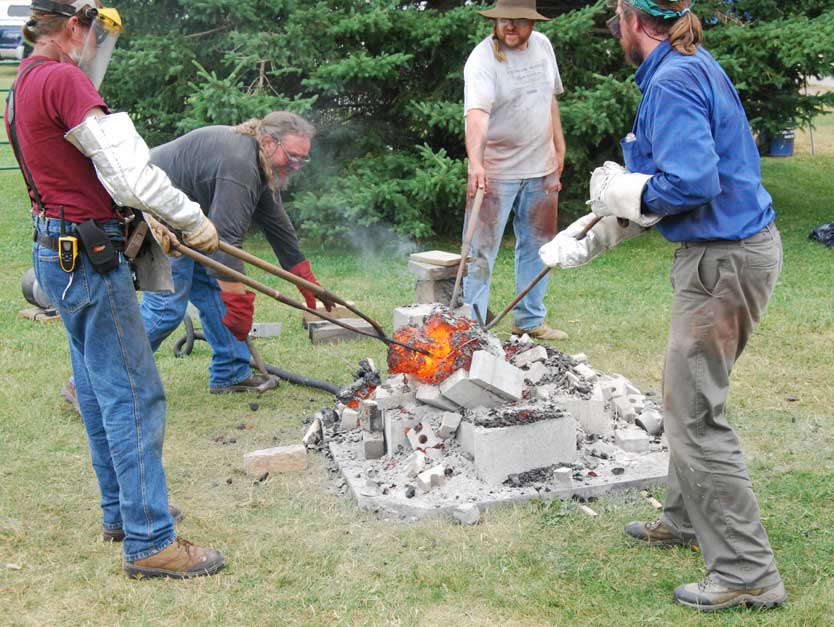
Go to the main Wareham Iron Smelting web site: DARC at CanIRON 8
(Image above by David Daciw)
skip to main |
skip to sidebar
October 9, 2011 / DARC Smelt Team, Neil Peterson recording
On our last smelt, we set up to record furnace temperatures over the duration of the experiment.

The furnace was our standard short shaft type, roughly 25 cm interior diameter, 70 cm total height.
Walls were clay and straw cobb, about 10 cm thickness.
Fuel was hardwood charcoal (mainly oak) graded to .5 through 2.5 cm diameters.
Air volume via the tuyere (set at 20 cm above base) was roughly 800 litres per minute.
Holes were drilled through the furnace walls at roughly every 10 cm, starting at 10 cm above the interior base.
Measurements were taken using an industrial quality digital pyrometer (Model HH12B from Omega with type K bare wire thermocouples).
The probes were inserted roughly 5 cm beyond the interior surface of the furnace wall.
Measurements were taken roughly every hour over the course of the smelt event.
Because the probes did not reach into the central core of the furnace, there is every possibility that the central furnace temperatures were even higher than what was recorded.
Our thermocouples failed (melted!) at roughly 1350 C. On several recordings, this temperature was reached.
Image : Neil takes readings, early in the smelt
Note: It has been suggested by some theoretical researchers that temperatures above 1200 C are impossible to achieve inside a charcoal fired furnace...
Cross posted from Hammered Out Bits

Showing the initial layout of the 'pit'. A standard 20 L plastic pail was surrounded by dirt, then filled to top with cut willow branches (about 0.5 - 1 cm diameter). Use of concrete blocks would allow for easy excavation after the experiment.

Our standard short shaft furnace is constructed on top of the pit. Clay with straw cobb, 25 cm ID, 70 cm tall. Ceramic tube tuyere (2.5 cm ID), electric blower.
Total time : 5 3/4 hours
Total charcoal : 57.5 kg
Total ore : 48 kg

Slag block as excavated (furnace itself was removed in one piece and retained for further use) There was no actual bloom recovered!

A fragment of the slag block, showing how hot slag had dripped down between the sticks, solidified, the heat converting the wood to charcoal. This from the front side of the furnace, indicating lack of iron (pale green colour). Slag to the rear of the furnace was a black iron rich colour.
The purity of the ore was questionable.
There is a chance some iron may exist trapped inside the slag block. A check with a magnet at the usual location (under the tuyere) did not indicate any however.
It is possible that the existing iron rich slag might be recovered, then utilized in a second smelt attempt.
For now we want to retain the slag block itself as a sample.

The extracted slag block. In this shot the tuyere is located to the upper right, directly above the scale vertical line. The colour shift in the slag from the rear to the front of the furnace is easily seen. There is an extra bulge in the slag about at ground level (the clay furnace sat directly on the loose dirt here.
A full report is in the works!
(duplicate from Hammered Out Bits)
Neil Peterson describing ancient iron and the ore used in the demonstration.
The furnace used is our 'Econo Norse' test / teaching set up, the ore our DD1 analog.
The result was a good soft iron at 5 kg.
The full smelt report is under preparation by Neil.
Saturday, October 29, 2011
Monday, October 24, 2011
Measuring the HEAT...
Iron Smelting Furnace Temperatures
Short Shaft over Slag Pit
October 9, 2011 / DARC Smelt Team, Neil Peterson recordingShort Shaft over Slag Pit
On our last smelt, we set up to record furnace temperatures over the duration of the experiment.

The furnace was our standard short shaft type, roughly 25 cm interior diameter, 70 cm total height.
Walls were clay and straw cobb, about 10 cm thickness.
Fuel was hardwood charcoal (mainly oak) graded to .5 through 2.5 cm diameters.
Air volume via the tuyere (set at 20 cm above base) was roughly 800 litres per minute.
Holes were drilled through the furnace walls at roughly every 10 cm, starting at 10 cm above the interior base.
Measurements were taken using an industrial quality digital pyrometer (Model HH12B from Omega with type K bare wire thermocouples).
The probes were inserted roughly 5 cm beyond the interior surface of the furnace wall.
Measurements were taken roughly every hour over the course of the smelt event.
Because the probes did not reach into the central core of the furnace, there is every possibility that the central furnace temperatures were even higher than what was recorded.
Our thermocouples failed (melted!) at roughly 1350 C. On several recordings, this temperature was reached.
Image : Neil takes readings, early in the smelt
| Time | Elapsed | base | tuyere | plus 10 | plus 20 | plus 30 | plus 40 | top |
| | | 10 cm | 20 cm | 30 cm | 40 cm | 50 cm | 60 cm | 70 cm |
| 12:06 | :06 | | 653 | 890 | 749 | 579 | 343 | |
| 13:05 | 1:05 | | 1042 | 1335 | 1300 | 1145 | 1002 | 610 |
| 13:50 | 1:50 | 328 | 1051 | plus 1350 | 1195 | 1189 | 1014 | 660 |
| 15:12 | 3:12 | 995 | 1226 | 1268 | 1293 | 1128 | 1011 | 608 |
| 16:32 | 4:32 | | | 1124 | 1265 * | 909 | 700 | 719 |
Note: It has been suggested by some theoretical researchers that temperatures above 1200 C are impossible to achieve inside a charcoal fired furnace...
Cross posted from Hammered Out Bits
Friday, October 21, 2011
Thanksgiving Smelt - fast overview
'Celtic Iron Age' slag pit furnace
October 9, 2011
DARC smelt team
(Darrell / Neil / Marcus)
DARC smelt team
(Darrell / Neil / Marcus)

Showing the initial layout of the 'pit'. A standard 20 L plastic pail was surrounded by dirt, then filled to top with cut willow branches (about 0.5 - 1 cm diameter). Use of concrete blocks would allow for easy excavation after the experiment.

Our standard short shaft furnace is constructed on top of the pit. Clay with straw cobb, 25 cm ID, 70 cm tall. Ceramic tube tuyere (2.5 cm ID), electric blower.
Total time : 5 3/4 hours
Total charcoal : 57.5 kg
Total ore : 48 kg

Slag block as excavated (furnace itself was removed in one piece and retained for further use) There was no actual bloom recovered!

A fragment of the slag block, showing how hot slag had dripped down between the sticks, solidified, the heat converting the wood to charcoal. This from the front side of the furnace, indicating lack of iron (pale green colour). Slag to the rear of the furnace was a black iron rich colour.
The purity of the ore was questionable.
There is a chance some iron may exist trapped inside the slag block. A check with a magnet at the usual location (under the tuyere) did not indicate any however.
It is possible that the existing iron rich slag might be recovered, then utilized in a second smelt attempt.
For now we want to retain the slag block itself as a sample.

The extracted slag block. In this shot the tuyere is located to the upper right, directly above the scale vertical line. The colour shift in the slag from the rear to the front of the furnace is easily seen. There is an extra bulge in the slag about at ground level (the clay furnace sat directly on the loose dirt here.
A full report is in the works!
(duplicate from Hammered Out Bits)
Saturday, October 1, 2011
Thanksgiving IRON SMELT at Wareham
One of the traditional iron smelt events at Wareham is over Thanksgiving
weekend. This is 'Darrell's Smelt' (originally a sad replacement for
Early Iron after that event was dropped). The DARC team normally takes
part.
Because Thanksgiving is a family day for many, and because some people get involved with the archery stuff in KW also that weekend, Smelt Day is SUNDAY.
The tentative plan for the weekend will be this:
Saturday - Furnace Build and Open workshop (self directed)
Sunday - Smelt Day
Monday - Evaluate and clean up
Vandy and I will be prepared to welcome guests any time after 9 AM.
The primary working day is SUNDAY, for those intending on a one day trip.
As usual, this is a 'limited open' event - please drop me a post back if you are intending on coming up.
Going into 2012, I want to work towards a new furnace type. I have proposed to Goderich Celtic Festival that I undertake a smelting demo at their event next August. This would be a Celtic Iron Age, slag pit type furnace. The style applies to early Danish and Anglo Saxon as well.
The upper portion of the planned furnace is going to be much like our standard types (short shaft, clay cobb construction). I have a wide number of ore types on hand, and have not determined which I may use. (Likely one of the Virginia rock ores, as I have considerable of those materials.)
Any working advice from our friends in England and Denmark, who have worked with these type of furnaces, would be helpful!
Because Thanksgiving is a family day for many, and because some people get involved with the archery stuff in KW also that weekend, Smelt Day is SUNDAY.
The tentative plan for the weekend will be this:
Saturday - Furnace Build and Open workshop (self directed)
Sunday - Smelt Day
Monday - Evaluate and clean up
Vandy and I will be prepared to welcome guests any time after 9 AM.
The primary working day is SUNDAY, for those intending on a one day trip.
As usual, this is a 'limited open' event - please drop me a post back if you are intending on coming up.
Going into 2012, I want to work towards a new furnace type. I have proposed to Goderich Celtic Festival that I undertake a smelting demo at their event next August. This would be a Celtic Iron Age, slag pit type furnace. The style applies to early Danish and Anglo Saxon as well.
The upper portion of the planned furnace is going to be much like our standard types (short shaft, clay cobb construction). I have a wide number of ore types on hand, and have not determined which I may use. (Likely one of the Virginia rock ores, as I have considerable of those materials.)
Any working advice from our friends in England and Denmark, who have worked with these type of furnaces, would be helpful!
Tuesday, September 27, 2011
Dr Wallace at Western!
Thursday, October 13th - 3:30 pm B&GS 0165
The UWO Northern Research Group presents:
Presenters: Dr. Birgitta Wallace: Viking archaeology at Vinland: a Cooperative Approach to Research
Abstract: In the popular mind archaeology is associated with structures and the finding of artifacts, but in reality, that is only part of the story. The environment and context of the site are equally important. Modern archaeology is dependent on interdisciplinary studies in a blend of natural sciences and humanities. The role of the archaeologist has become that of coordinator, drawing on whatever branch of knowledge pertains to the project on which he or she is working. The Viking site at L’Anse aux Meadows National Historic Site in northern Newfoundland is an example of how natural sciences, combined with anthropological, folkloristic, historical, literary and linguistic studies, have given new insight into the world of the Vinland sagas and the contacts of the Norse with the New World.
This event is being held at the University of Western Ontario, London.
Venue (appears?) the Biological and Geological Sciences Building
View Larger Map
Venue (appears?) the Biological and Geological Sciences Building
View Larger Map
Birgitta is an old friend and sometimes adviser to those of us in DARC (and my special 'fairy godmother'.)
Tuesday, September 6, 2011
CanIRON 8 Iron Smelt
This is a clip shot at the recent CanIRON 8 demo by Neil, Richard and Dave.
Neil Peterson describing ancient iron and the ore used in the demonstration.
The furnace used is our 'Econo Norse' test / teaching set up, the ore our DD1 analog.
The result was a good soft iron at 5 kg.
The full smelt report is under preparation by Neil.
Saturday, August 13, 2011
Glass Bead Furnace at Goderich Celtic
Cross posted from Darrell's Hammered Out Bits
As part of my nefarious plans * for the Earth, Air Celtic Festival at Goderich, this year's demonstration was of a Viking Age glass bead making furnace.
Now, this is really the research project of Neil Peterson, fellow member of DARC. Neil has driven the project, and has applied his (considerable) analytical powers to understanding the related archaeological remains. Much of our work has been focused on the remains from Ribe, Denmark. One of the problems is that the actual bead making furnaces are only represented by a number of clay base plates, with none of the upper portions of the furnaces surviving. There are plentiful examples of scrap and waste glass from the making process, as well as a large number of various styles of completed beads. As glass is virtually indestructible, glass beads are a common grave find as well.
My contribution to the beginning of the project was as the 'fire guy', lending my forge experience to the problem of how to construct and operate a charcoal burning glass furnace. It quickly was apparent to me that I needed some direct experience with how glass bead making works! To that end I assembled a basic set of modern lamp working tools and supplies, and made roughly 150 beads - just to get the hang of it.
Neil had made the furnace up a week before and allowed it to air dry. The construction is made of our standard 50 / 50 mix of powdered clay / shredded dry horse manure. The base oval is roughly 30 x 60 cm, and it stands about 30 cm tall. This is the ninth rendition of the basic plan, which at this point is close to an effective layout in terms of heat generation and functional spaces. (For some discussion of alternative designs and functional aspects, see an earlier posting. )
One continuing point of experimentation remains the problem of creating the required temperatures for glass working - and sustaining them, within the furnace. Charcoal supplied with a gentle (!) air blast will certainly produce the required temperatures. One problem remains getting heat without excessive ash floating around (and sticking to the surface of the beads).
One very successful addition to the interior of the furnace is to place a triangular diverter on the wall directly opposite the tuyere entry. Combined with a slight down angle to the tuyere, the net effect is a spiral pattern to the air flow and thus heat generation pattern. In this furnace, this circular pattern was clear in the way the charcoal was consumed.
Our current furnaces provide two possible working methods.
One is inside the furnace, through a port cut into the two long axis ends. For this furnace, Neil and I made slightly different cut angles and locations. I had kept to a more rectangular shape, and also cut the angle of the upper edge so it sloped upwards into the furnace. Generally this proved more effective in reducing some of the volume of hot air blast escaping towards the operator.
The second working area is inside the exhaust stack on the top of the furnace. Although a fresh charge of charcoal certainly provides enough heat here to bring the glass to working temperatures, the effective duration remains short. I think some additional refinements in the shape of the upper structure may improve the function of the stack area.
I worked as much as possible with the two types of tesseri (broken tiles) that Neil had purchased. By this point I (more or less) have managed to figure out how to take an irregular rectangle and wind it up to a roughly ball shape on a mandrill.
One important addition to our working method was developed by Neil over this session.
I can more or less manage a bead shape, even a bead with some decoration. Where it comes apart for me (literally) is in getting the finished bead off the mandrill! Neil had looked closely at a video of traditional workers and seen that they were able to tap off a still hot bead with a metal tool. After a number of failures, he discovered the key is in tapping the mandrill first, which seems to break up and loosen the applied clay separator / resist.
Although not shot at Goderich, there is a video clip on YouTube which shows an earlier experiment in this series.
For more information on the ongoing research into Norse glass beads and making, see the area on the DARC web site.
* Evil Nefarious Plan:
Is to introduce an element of archaeology, specifically Experimental Archaeology, into the fabric of the Festival. Next year marks 20 years for the Earth, Air Celtic Festival. I have tentative approval to build and operate a Celtic Iron Age, slag pit styled, iron smelting furnace as the public demonstration. In conjunction, my intended Celtic College offering will be 'Ancient Celtic Ironwork'. Students will work with a ground pit charcoal forge, bellows air and small block anvils. The likely projects will be small knives and spear points. On the last College session, they will aid in constructing the smelting furnace.
The day long firing of the furnace will be a major demonstration at the Festival, allowing for direct participation of students and others.
It will certainly be the very first time this type of furnace has ever been publicly presented in Canada, perhaps the first time in all of North America.

As part of my nefarious plans * for the Earth, Air Celtic Festival at Goderich, this year's demonstration was of a Viking Age glass bead making furnace.
Now, this is really the research project of Neil Peterson, fellow member of DARC. Neil has driven the project, and has applied his (considerable) analytical powers to understanding the related archaeological remains. Much of our work has been focused on the remains from Ribe, Denmark. One of the problems is that the actual bead making furnaces are only represented by a number of clay base plates, with none of the upper portions of the furnaces surviving. There are plentiful examples of scrap and waste glass from the making process, as well as a large number of various styles of completed beads. As glass is virtually indestructible, glass beads are a common grave find as well.
My contribution to the beginning of the project was as the 'fire guy', lending my forge experience to the problem of how to construct and operate a charcoal burning glass furnace. It quickly was apparent to me that I needed some direct experience with how glass bead making works! To that end I assembled a basic set of modern lamp working tools and supplies, and made roughly 150 beads - just to get the hang of it.
Neil had made the furnace up a week before and allowed it to air dry. The construction is made of our standard 50 / 50 mix of powdered clay / shredded dry horse manure. The base oval is roughly 30 x 60 cm, and it stands about 30 cm tall. This is the ninth rendition of the basic plan, which at this point is close to an effective layout in terms of heat generation and functional spaces. (For some discussion of alternative designs and functional aspects, see an earlier posting. )
One continuing point of experimentation remains the problem of creating the required temperatures for glass working - and sustaining them, within the furnace. Charcoal supplied with a gentle (!) air blast will certainly produce the required temperatures. One problem remains getting heat without excessive ash floating around (and sticking to the surface of the beads).
One very successful addition to the interior of the furnace is to place a triangular diverter on the wall directly opposite the tuyere entry. Combined with a slight down angle to the tuyere, the net effect is a spiral pattern to the air flow and thus heat generation pattern. In this furnace, this circular pattern was clear in the way the charcoal was consumed.
Our current furnaces provide two possible working methods.
One is inside the furnace, through a port cut into the two long axis ends. For this furnace, Neil and I made slightly different cut angles and locations. I had kept to a more rectangular shape, and also cut the angle of the upper edge so it sloped upwards into the furnace. Generally this proved more effective in reducing some of the volume of hot air blast escaping towards the operator.
The second working area is inside the exhaust stack on the top of the furnace. Although a fresh charge of charcoal certainly provides enough heat here to bring the glass to working temperatures, the effective duration remains short. I think some additional refinements in the shape of the upper structure may improve the function of the stack area.
I worked as much as possible with the two types of tesseri (broken tiles) that Neil had purchased. By this point I (more or less) have managed to figure out how to take an irregular rectangle and wind it up to a roughly ball shape on a mandrill.
One important addition to our working method was developed by Neil over this session.
I can more or less manage a bead shape, even a bead with some decoration. Where it comes apart for me (literally) is in getting the finished bead off the mandrill! Neil had looked closely at a video of traditional workers and seen that they were able to tap off a still hot bead with a metal tool. After a number of failures, he discovered the key is in tapping the mandrill first, which seems to break up and loosen the applied clay separator / resist.
Although not shot at Goderich, there is a video clip on YouTube which shows an earlier experiment in this series.
For more information on the ongoing research into Norse glass beads and making, see the area on the DARC web site.
* Evil Nefarious Plan:
Is to introduce an element of archaeology, specifically Experimental Archaeology, into the fabric of the Festival. Next year marks 20 years for the Earth, Air Celtic Festival. I have tentative approval to build and operate a Celtic Iron Age, slag pit styled, iron smelting furnace as the public demonstration. In conjunction, my intended Celtic College offering will be 'Ancient Celtic Ironwork'. Students will work with a ground pit charcoal forge, bellows air and small block anvils. The likely projects will be small knives and spear points. On the last College session, they will aid in constructing the smelting furnace.
The day long firing of the furnace will be a major demonstration at the Festival, allowing for direct participation of students and others.
It will certainly be the very first time this type of furnace has ever been publicly presented in Canada, perhaps the first time in all of North America.
Subscribe to:
Posts (Atom)
Labels
- Cooking (1)
- events (39)
- experimental archaeology (16)
- glass (12)
- interpreting (4)
- iron smelting (11)
- media review (1)
- object (6)
- public presentations (23)
- research (3)
- textile (4)
- travel tales (19)
- Viking Age (27)
- Vinland (37)
DARC Links
DARC Calendar
| Date | Event |
|---|---|
| May 2-4, 2019 | EAC 11, Trento, IT* |
| May 9-12, 2019 | EXARC Session at ICMS, Kalamazoo, MI |
| May ??, 2019 | Open Workshop* |
| Jun 8-10, 2019 | Upper Canada Village Medieval Faire Presentation |
| Jun 29, 2019 | Smelt |
| Jul ??, 2019 | Bead Burn* |
| Aug ??, 2019 | Bead Burn* |
| Sep 6-8, 2019 | Althing (SCA Event) |
| Sep 15, 2019 | CAMELOT, Waterloo, ON |
| Oct 5, 2019 | Bogenschutzenfest, Kitchener, ON |
| Oct 12, 2019 | Smelt |
| Oct 25-26, 2019 | REARC, Williamsburg, VA |
| Nov 2, 2019 | Smelt |
| * | tentative |
Contributors
- Darrell Markewitz
- Karen Peterson
- Neil Peterson
- Vandy Simpson
- Contact Us: info@darkcompany.ca