




Nothing can bring the Viking Age to life like costumed historic interpreters surrounded with the personal goods and tools of the past. Artefacts that seem puzzling when seen in a museum exhibit or book suddenly become clear when seen in use or in placed in your hand.
The Dark Ages Recreation Company has once again been invited by Parks Canada to come and demonstrate the living history of the first Europeans to explore North America at L'Anse aux Meadows NHSC in Newfoundland. As a part of our preparation for this presentation in August, we are mounting a full dress run-through in Wareham on June 12th from 10am to 4pm.
You are most welcome to drop by and visit with members of the company as they practice their skills and fine tune the presentation areas. This presentation will be of particular interest to students in Grade 6 (Explorer's unit) or Grade 11 (archaeology), teachers involved in those topic areas, or other groups with an interest in traditional historic skills such as scouts and guides.
There are no fees to attend this special event!
Wareham is located just of highway 10, close to Flesherton Ontario. Directions are available on the Wareham Forge Website. (http://www.warehamforge.ca/directions/shopmap.gif)
Living History - What does it look like?
DARC focuses on daily life in the Viking Age. The presentation will centre on a 'camp', with costumed interpreters surrounded by a collection of replica objects consisting of domestic goods, tools, and storage. At the rehearsal, simple overhead covers and tents will mimic the buildings which we will use at L'Anse aux Meadows. Individuals will be outfitted with the tools of their various trades and arts, all representing our real interests and skills. (We really are weavers and cooks, blacksmiths and carvers.) All of the objects seen, from clothing to tents, are based on specific artifact prototypes.
To the public, the members of DARC present themselves as actual voices from the past, with shared experiences as a group and direct personal histories. Individual members of DARC have prepared detailed characterizations based on their personal research into the Viking Age, developing considerable expertise in specialized areas. These characters are the 'common man': artisans, merchants or farmers typical of the Norse of the North Atlantic circa 1000 AD. Any conversation is likely to begin at this 'role playing' level of historic interpretation. The interpretive level used is then shifted to suit the needs of individual visitors. Some people delight in talking to a character from 1000 years ago, others are more comfortable with more of a modern commentary. Interpreters are able to handle a wide range of topics and level of detail.
Demonstrations being prepared for this presentation will include:
* antler and bone carving
* soapstone carving
* spinning
* natural dyes
* game playing
* simple musical instruments
* wood work (spring pole lathe)
* coin minting
* weaving
* iron smelting (did you know that the norse made the first iron in Canada 500 years before Columbus arrived?)
The use of replicas, although still historically accurate, allows the public to personally handle tools and materials. In many cases you can actually try a technique or help out with a task.
A team with proven experience!
DARC has provided skilled and well equipped interpreters for special programs for all of the major events and exhibitions that marked the 'Viking Millennium' in Canada. No other group of Canadian re-enactors has as much accumulated museum experience. As a group and as individuals, members have worked both throughout Canada and the USA. Personal research has taken members to museums and archaeological sites across Iceland, the United Kingdom and Scandinavia.
Interested in Discussing Details?
Darrell Markewitz - organizes DARC's museum presentations and serves as the museum contact. Not only one of the original founders of DARC, he brings extensive museum experience as a consultant on educational programing and staff trainer for Parks Canada and other major institutions.
email: dark@warehamforge.ca
Darrell Markewitz
Interpretive Program Designer
Hamlet of Wareham
RR # 2 - Proton Station, Ontario
N0C 1L0 Canada
(519) 923-9219
Monday, May 10, 2010


Friday, April 30, 2010
A ROUGH site plan

This is a site plan of the Encampment Compound as it exists at L'Anse aux Meadows NHSC.
To prepare this, I worked from the scaled architect's drawing of the compound, as it was proposed in the early 1980's. To this I added the room dimensions from the archaeology from Wallace's Westward Vikings.
I had a long talk with Loretta Decker, the site manager at LAM on Wednesday, and the current uses for the various spaces are indicated. Typically Parks has 3 costumed staff in place (Mark as smith, Bonnie as textiles, Mike as chieftain), and rarely more than 5 or 6. This then puts Parks staff at Main 4 / Main 1 and Dwelling.
Loretta has suggested she would like to see DARC integrate fairly closely with the existing interpretive staff. This rather than the more 'arms length' arrangement our original scenario had proposed.
- Weaving would be centred on Main 4, with both looms set up and working if space permits (just ours if not).
- Iron working would shift over to Furnace, with some smithing, but primarily preparation for the smelt
- Main 3, normally not staffed, would contain our woodworking, possible carving
- Dwelling would contain our food preparation, and also our night storage.
Storage could be outfitted as Slave Quarters
Main 2 is available as a station
Main 1 would remain primarily as Parks, with spill over from DARC likely
Interior Yard is likely for domestic tasks like clothes washing
The facing for the three tents is indicated by the arrows:
A - Trade and Games
B - Lathe
C - Bondi (kids?)
I still have to work up the exact placement of the various skills, primary and secondary. Also alternates for foul weather. I suspect that many activities will be easy to move outside as well, so positions there need to be determined as well. A balance between the core team and the additionals, alternate positions during experimental archaeology demonstrations.
Wednesday, April 21, 2010
Icelandic (?) Pattern Loom for Vinland
One of the current objects under construction here is a warp weighted loom, commissioned by Karen Peterson.
With the living history presentation by DARC at L'Anse aux Meadows NHSC coming up this summer (August 16 - 25, 2010) the entire group is re-working a LOT of our equipments. Everyone in DARC is making a very special effort to make this presentation of the very highest standard. Our normal museum display focuses on a more 'urban' view, centred on the 'life of the craftsman'. The objects are typically chosen from a greater span of both geography and time. For the DARC at Vinland presentation, we are tightening up to 1000 - 1010 AD and to primarily Greenland and Iceland for our prototypes. (An ongoing discussion of how this effects our presentation can be found on the original DARC blog.)
Textile production is a major element in DARC's combined skill set and physical presentations. This is especially the case for the story of LAM, where one of the signature artifacts was a small soapstone spindle whorl.
My concern is that the several warp weighted looms currently being used by various members of the group (at least four) are all too 'modern' in their construction details. (Beware: Textile jargon coming up!)
The historic prototypes:
Images above by Karen Peterson
After considerable discussion, it was decided to build a new loom. The key was to not only consider the artifact prototypes available, but also the raw materials available on hand in both Iceland and Vinland circa 1000 AD. One primary problem in looking at the existing samples is that all of them are at best no older than the 1700's. Almost all have been heavily restored. A good number of those on display in museum collections are in fact modern replicas. Our own textile workers have been known to be puzzled by some of those on display. "Well, that just will not work!" is a repeated comment. (Few museum displays are actually set up by involved workers in the related skills, see any of my earlier comments on blacksmithing exhibits.)
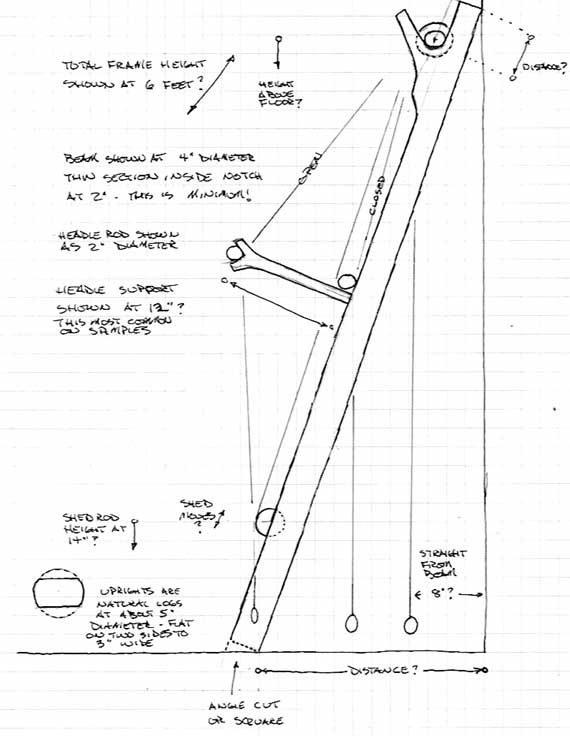
The primary difference between the more 'continental' style and a distinctively 'Icelandic' style of loom appears to be in the difference in how the heddle bar is supported. (The heddle bar is the horizontal rod to which one set of the up and down warp threads are attached.) The more commonly used method in most re-constructions I have seen uses the form seen on the Old Scatness sample. That is a pair of forked branches or notched boards, which fit into a series of holes running along the uprights. This arrangement allows for adjusting the distance and position of the heddle rod, and thus controls the width of the shed (distance between front and back warp threads). This arrangement is physically quite strong, as the considerable force caused by supporting the loom weights will push straight back down the shed support rods and back into the frame.
On the Icelandic pattern, the heddle supports are two longer poles or planks, wedged between the floor and the lower horizontal line of the shed support. The advantage of this method is both ease of construction and that it is almost infinitely adjustable. The major problem is that now the force of the loom weights is directed in a diagonal line against the side of the shafts.
In truth, as the major elements of the frame of the loom are virtually identical, it was decided to design the new loom to allow it to be mounted up for either method. There would be the required holes drilled in the uprights and a set of forked shed supports, plus the longer and heavier rods included to set up for the Icelandic tradition.
In all the 'artifact' samples, the two uprights have been flattened off on two sides. The supporting fork at the top of the uprights (for the top beam) are made of separate pieces, cut to shape and pinned into place. This is a significantly weaker construction method, as the load runs across the direction of the grain, and all the weight is entirely born by the two pins. A better method is to use two natural limb joints, where the grain will run around the fork and so is significantly stronger. The ideal way to attach these as separate pieces would be to set them into a large dovetail joint. (Readers will note that this is Evil Wood talk : 'I said I don't have much use for them, not that I don't know HOW to use them'.) In the end I decided to use one piece naturally forked limbs to ensure strength but reduce complexity.
The next concern was about materials, and how these might fit into our proposed scenario for DARC at Vinland. Initially it was suggested that 'Ka∂lin' would be a 'professional' weaver, and as such would likely have brought her loom with her on the immigration trip from Iceland. Karen, however, was a bit concerned that this story element might overplay her actual weaving skills. As a compromise, it was decided that the loom she would would work on at LAM would be one that could have been constructed at Vinland itself, perhaps skillfully built (?) but of available local materials. Birch was chosen, as it was available in both Iceland (still) and Vinland circa 1000 AD.
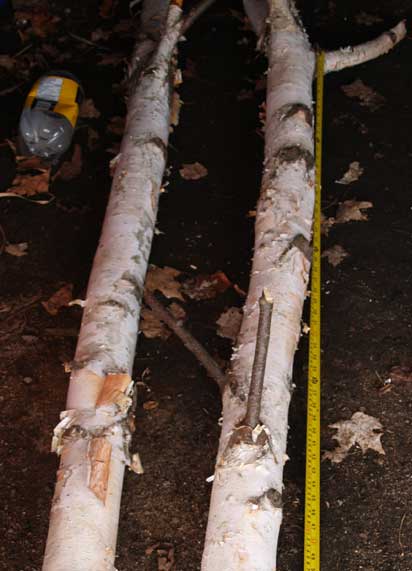
To that end, in mid March I wandered off into a local woodlot (where I have permission to cut). After three hours slogging around in mushy snow and melt water pools, I selected two standing birch trees to fell. This proved much harder than it might seem, I looked a dozens of trees through the swampy area. The key was finding two in the right size range (5 - 6 inch diameter) with naturally occurring forks in the correct configuration. Even cut down to an eight foot length, a six inch green log is damn heavy! I also gathered a standing but long dead (and dry) spruce sapling. This piece is dead straight, and tapers evenly from 3 1/3 inches at the base through to about 3/4 an inch - over a 23 foot length. I ended up making a second trip into the bush later to return to the cutting sites to gather smaller diameter forked branches to use for the shed supports and beam winding shafts.
The first step was removing all the bark. To keep the whole project looking as 'authentic as possible, this work was done using a hand axe. The smaller existing branches would be trimmed back to short lengths, providing a number of natural hooks for eventual hanging of weaving tools.
Special attention was given to the method of cutting the ends of the top beam. These ends would be clearly visible. So they were cut more or less flush by using the hand axe and a mallet. This does leave an entirely different finish than slicing off with a modern saw.
YouTube segment showing the preparation of the raw logs.
The images above show the majority of the loom's frame completed.
BELOW : The completed loom. You will see it has three positions for the lower shed support. There are a total of 4 positions for the heddle support rods. (You may notice this is the more standard layout, the two longer pole pieces for the Icelandic method will be made up later.)
 (Darrell)
With the living history presentation by DARC at L'Anse aux Meadows NHSC coming up this summer (August 16 - 25, 2010) the entire group is re-working a LOT of our equipments. Everyone in DARC is making a very special effort to make this presentation of the very highest standard. Our normal museum display focuses on a more 'urban' view, centred on the 'life of the craftsman'. The objects are typically chosen from a greater span of both geography and time. For the DARC at Vinland presentation, we are tightening up to 1000 - 1010 AD and to primarily Greenland and Iceland for our prototypes. (An ongoing discussion of how this effects our presentation can be found on the original DARC blog.)
Textile production is a major element in DARC's combined skill set and physical presentations. This is especially the case for the story of LAM, where one of the signature artifacts was a small soapstone spindle whorl.
My concern is that the several warp weighted looms currently being used by various members of the group (at least four) are all too 'modern' in their construction details. (Beware: Textile jargon coming up!)
The historic prototypes:
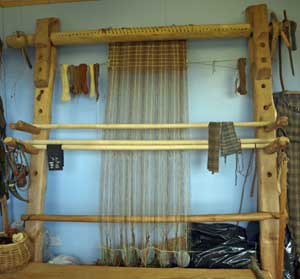 | 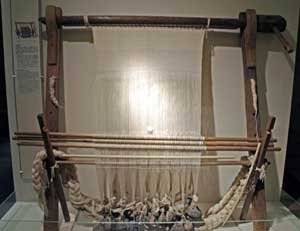 | 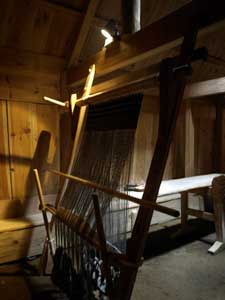 |
| Old Scatness, Scotland Likely 1800's? | National Museum of Iceland Perhaps 1700's? | Stong Farmstead, Iceland Modern reconstruction |
Images above by Karen Peterson
After considerable discussion, it was decided to build a new loom. The key was to not only consider the artifact prototypes available, but also the raw materials available on hand in both Iceland and Vinland circa 1000 AD. One primary problem in looking at the existing samples is that all of them are at best no older than the 1700's. Almost all have been heavily restored. A good number of those on display in museum collections are in fact modern replicas. Our own textile workers have been known to be puzzled by some of those on display. "Well, that just will not work!" is a repeated comment. (Few museum displays are actually set up by involved workers in the related skills, see any of my earlier comments on blacksmithing exhibits.)
The primary difference between the more 'continental' style and a distinctively 'Icelandic' style of loom appears to be in the difference in how the heddle bar is supported. (The heddle bar is the horizontal rod to which one set of the up and down warp threads are attached.) The more commonly used method in most re-constructions I have seen uses the form seen on the Old Scatness sample. That is a pair of forked branches or notched boards, which fit into a series of holes running along the uprights. This arrangement allows for adjusting the distance and position of the heddle rod, and thus controls the width of the shed (distance between front and back warp threads). This arrangement is physically quite strong, as the considerable force caused by supporting the loom weights will push straight back down the shed support rods and back into the frame.
On the Icelandic pattern, the heddle supports are two longer poles or planks, wedged between the floor and the lower horizontal line of the shed support. The advantage of this method is both ease of construction and that it is almost infinitely adjustable. The major problem is that now the force of the loom weights is directed in a diagonal line against the side of the shafts.
In truth, as the major elements of the frame of the loom are virtually identical, it was decided to design the new loom to allow it to be mounted up for either method. There would be the required holes drilled in the uprights and a set of forked shed supports, plus the longer and heavier rods included to set up for the Icelandic tradition.
In all the 'artifact' samples, the two uprights have been flattened off on two sides. The supporting fork at the top of the uprights (for the top beam) are made of separate pieces, cut to shape and pinned into place. This is a significantly weaker construction method, as the load runs across the direction of the grain, and all the weight is entirely born by the two pins. A better method is to use two natural limb joints, where the grain will run around the fork and so is significantly stronger. The ideal way to attach these as separate pieces would be to set them into a large dovetail joint. (Readers will note that this is Evil Wood talk : 'I said I don't have much use for them, not that I don't know HOW to use them'.) In the end I decided to use one piece naturally forked limbs to ensure strength but reduce complexity.
The next concern was about materials, and how these might fit into our proposed scenario for DARC at Vinland. Initially it was suggested that 'Ka∂lin' would be a 'professional' weaver, and as such would likely have brought her loom with her on the immigration trip from Iceland. Karen, however, was a bit concerned that this story element might overplay her actual weaving skills. As a compromise, it was decided that the loom she would would work on at LAM would be one that could have been constructed at Vinland itself, perhaps skillfully built (?) but of available local materials. Birch was chosen, as it was available in both Iceland (still) and Vinland circa 1000 AD.
To that end, in mid March I wandered off into a local woodlot (where I have permission to cut). After three hours slogging around in mushy snow and melt water pools, I selected two standing birch trees to fell. This proved much harder than it might seem, I looked a dozens of trees through the swampy area. The key was finding two in the right size range (5 - 6 inch diameter) with naturally occurring forks in the correct configuration. Even cut down to an eight foot length, a six inch green log is damn heavy! I also gathered a standing but long dead (and dry) spruce sapling. This piece is dead straight, and tapers evenly from 3 1/3 inches at the base through to about 3/4 an inch - over a 23 foot length. I ended up making a second trip into the bush later to return to the cutting sites to gather smaller diameter forked branches to use for the shed supports and beam winding shafts.
The first step was removing all the bark. To keep the whole project looking as 'authentic as possible, this work was done using a hand axe. The smaller existing branches would be trimmed back to short lengths, providing a number of natural hooks for eventual hanging of weaving tools.
Special attention was given to the method of cutting the ends of the top beam. These ends would be clearly visible. So they were cut more or less flush by using the hand axe and a mallet. This does leave an entirely different finish than slicing off with a modern saw.
YouTube segment showing the preparation of the raw logs.
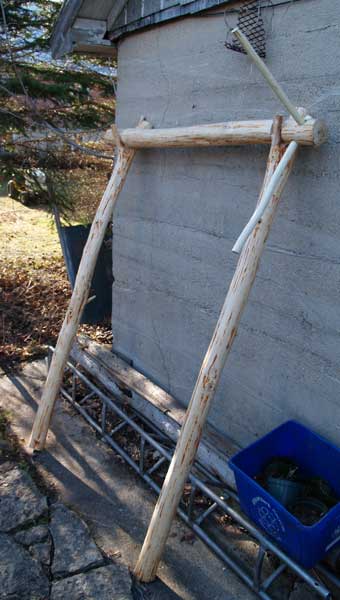 | 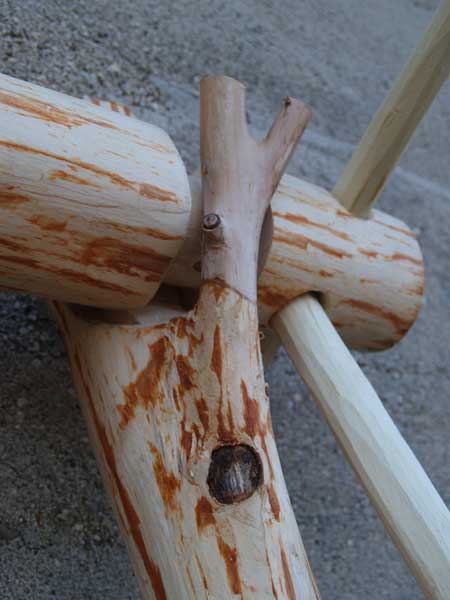 |
| Frame under construction | Detail of beam and upright |
The images above show the majority of the loom's frame completed.
BELOW : The completed loom. You will see it has three positions for the lower shed support. There are a total of 4 positions for the heddle support rods. (You may notice this is the more standard layout, the two longer pole pieces for the Icelandic method will be made up later.)
(Darrell)
Icelandic (?) Pattern Loom for Vinland
One of the current objects under construction here is a warp weighted loom, commissioned by Karen Peterson.
With the living history presentation by DARC at L'Anse aux Meadows NHSC coming up this summer (August 16 - 25, 2010) the entire group is re-working a LOT of our equipments. Everyone in DARC is making a very special effort to make this presentation of the very highest standard. Our normal museum display focuses on a more 'urban' view, centred on the 'life of the craftsman'. The objects are typically chosen from a greater span of both geography and time. For the DARC at Vinland presentation, we are tightening up to 1000 - 1010 AD and to primarily Greenland and Iceland for our prototypes. (An ongoing discussion of how this effects our presentation can be found on the original DARC blog.)
Textile production is a major element in DARC's combined skill set and physical presentations. This is especially the case for the story of LAM, where one of the signature artifacts was a small soapstone spindle whorl.
My concern is that the several warp weighted looms currently being used by various members of the group (at least four) are all too 'modern' in their construction details. (Beware: Textile jargon coming up!)
The historic prototypes:
Images above by Karen Peterson
After considerable discussion, it was decided to build a new loom. The key was to not only consider the artifact prototypes available, but also the raw materials available on hand in both Iceland and Vinland circa 1000 AD. One primary problem in looking at the existing samples is that all of them are at best no older than the 1700's. Almost all have been heavily restored. A good number of those on display in museum collections are in fact modern replicas. Our own textile workers have been known to be puzzled by some of those on display. "Well, that just will not work!" is a repeated comment. (Few museum displays are actually set up by involved workers in the related skills, see any of my earlier comments on blacksmithing exhibits.)
The primary difference between the more 'continental' style and a distinctively 'Icelandic' style of loom appears to be in the difference in how the heddle bar is supported. (The heddle bar is the horizontal rod to which one set of the up and down warp threads are attached.) The more commonly used method in most re-constructions I have seen uses the form seen on the Old Scatness sample. That is a pair of forked branches or notched boards, which fit into a series of holes running along the uprights. This arrangement allows for adjusting the distance and position of the heddle rod, and thus controls the width of the shed (distance between front and back warp threads). This arrangement is physically quite strong, as the considerable force caused by supporting the loom weights will push straight back down the shed support rods and back into the frame.
On the Icelandic pattern, the heddle supports are two longer poles or planks, wedged between the floor and the lower horizontal line of the shed support. The advantage of this method is both ease of construction and that it is almost infinitely adjustable. The major problem is that now the force of the loom weights is directed in a diagonal line against the side of the shafts.
In truth, as the major elements of the frame of the loom are virtually identical, it was decided to design the new loom to allow it to be mounted up for either method. There would be the required holes drilled in the uprights and a set of forked shed supports, plus the longer and heavier rods included to set up for the Icelandic tradition.
In all the 'artifact' samples, the two uprights have been flattened off on two sides. The supporting fork at the top of the uprights (for the top beam) are made of separate pieces, cut to shape and pinned into place. This is a significantly weaker construction method, as the load runs across the direction of the grain, and all the weight is entirely born by the two pins. A better method is to use two natural limb joints, where the grain will run around the fork and so is significantly stronger. The ideal way to attach these as separate pieces would be to set them into a large dovetail joint. (Readers will note that this is Evil Wood talk : 'I said I don't have much use for them, not that I don't know HOW to use them'.) In the end I decided to use one piece naturally forked limbs to ensure strength but reduce complexity.
The next concern was about materials, and how these might fit into our proposed scenario for DARC at Vinland. Initially it was suggested that 'Ka∂lin' would be a 'professional' weaver, and as such would likely have brought her loom with her on the immigration trip from Iceland. Karen, however, was a bit concerned that this story element might overplay her actual weaving skills. As a compromise, it was decided that the loom she would would work on at LAM would be one that could have been constructed at Vinland itself, perhaps skillfully built (?) but of available local materials. Birch was chosen, as it was available in both Iceland (still) and Vinland circa 1000 AD.
To that end, in mid March I wandered off into a local woodlot (where I have permission to cut). After three hours slogging around in mushy snow and melt water pools, I selected two standing birch trees to fell. This proved much harder than it might seem, I looked a dozens of trees through the swampy area. The key was finding two in the right size range (5 - 6 inch diameter) with naturally occurring forks in the correct configuration. Even cut down to an eight foot length, a six inch green log is damn heavy! I also gathered a standing but long dead (and dry) spruce sapling. This piece is dead straight, and tapers evenly from 3 1/3 inches at the base through to about 3/4 an inch - over a 23 foot length. I ended up making a second trip into the bush later to return to the cutting sites to gather smaller diameter forked branches to use for the shed supports and beam winding shafts.
The first step was removing all the bark. To keep the whole project looking as 'authentic as possible, this work was done using a hand axe. The smaller existing branches would be trimmed back to short lengths, providing a number of natural hooks for eventual hanging of weaving tools.
Special attention was given to the method of cutting the ends of the top beam. These ends would be clearly visible. So they were cut more or less flush by using the hand axe and a mallet. This does leave an entirely different finish than slicing off with a modern saw.
YouTube segment showing the preparation of the raw logs.
The images above show the majority of the loom's frame completed.
BELOW : The completed loom. You will see it has three positions for the lower shed support. There are a total of 4 positions for the heddle support rods. (You may notice this is the more standard layout, the two longer pole pieces for the Icelandic method will be made up later.)
(Darrell)
With the living history presentation by DARC at L'Anse aux Meadows NHSC coming up this summer (August 16 - 25, 2010) the entire group is re-working a LOT of our equipments. Everyone in DARC is making a very special effort to make this presentation of the very highest standard. Our normal museum display focuses on a more 'urban' view, centred on the 'life of the craftsman'. The objects are typically chosen from a greater span of both geography and time. For the DARC at Vinland presentation, we are tightening up to 1000 - 1010 AD and to primarily Greenland and Iceland for our prototypes. (An ongoing discussion of how this effects our presentation can be found on the original DARC blog.)
Textile production is a major element in DARC's combined skill set and physical presentations. This is especially the case for the story of LAM, where one of the signature artifacts was a small soapstone spindle whorl.
My concern is that the several warp weighted looms currently being used by various members of the group (at least four) are all too 'modern' in their construction details. (Beware: Textile jargon coming up!)
The historic prototypes:
| | |
| Old Scatness, Scotland Likely 1800's? | National Museum of Iceland Perhaps 1700's? | Stong Farmstead, Iceland Modern reconstruction |
Images above by Karen Peterson
After considerable discussion, it was decided to build a new loom. The key was to not only consider the artifact prototypes available, but also the raw materials available on hand in both Iceland and Vinland circa 1000 AD. One primary problem in looking at the existing samples is that all of them are at best no older than the 1700's. Almost all have been heavily restored. A good number of those on display in museum collections are in fact modern replicas. Our own textile workers have been known to be puzzled by some of those on display. "Well, that just will not work!" is a repeated comment. (Few museum displays are actually set up by involved workers in the related skills, see any of my earlier comments on blacksmithing exhibits.)
The primary difference between the more 'continental' style and a distinctively 'Icelandic' style of loom appears to be in the difference in how the heddle bar is supported. (The heddle bar is the horizontal rod to which one set of the up and down warp threads are attached.) The more commonly used method in most re-constructions I have seen uses the form seen on the Old Scatness sample. That is a pair of forked branches or notched boards, which fit into a series of holes running along the uprights. This arrangement allows for adjusting the distance and position of the heddle rod, and thus controls the width of the shed (distance between front and back warp threads). This arrangement is physically quite strong, as the considerable force caused by supporting the loom weights will push straight back down the shed support rods and back into the frame.
On the Icelandic pattern, the heddle supports are two longer poles or planks, wedged between the floor and the lower horizontal line of the shed support. The advantage of this method is both ease of construction and that it is almost infinitely adjustable. The major problem is that now the force of the loom weights is directed in a diagonal line against the side of the shafts.
In truth, as the major elements of the frame of the loom are virtually identical, it was decided to design the new loom to allow it to be mounted up for either method. There would be the required holes drilled in the uprights and a set of forked shed supports, plus the longer and heavier rods included to set up for the Icelandic tradition.
In all the 'artifact' samples, the two uprights have been flattened off on two sides. The supporting fork at the top of the uprights (for the top beam) are made of separate pieces, cut to shape and pinned into place. This is a significantly weaker construction method, as the load runs across the direction of the grain, and all the weight is entirely born by the two pins. A better method is to use two natural limb joints, where the grain will run around the fork and so is significantly stronger. The ideal way to attach these as separate pieces would be to set them into a large dovetail joint. (Readers will note that this is Evil Wood talk : 'I said I don't have much use for them, not that I don't know HOW to use them'.) In the end I decided to use one piece naturally forked limbs to ensure strength but reduce complexity.
The next concern was about materials, and how these might fit into our proposed scenario for DARC at Vinland. Initially it was suggested that 'Ka∂lin' would be a 'professional' weaver, and as such would likely have brought her loom with her on the immigration trip from Iceland. Karen, however, was a bit concerned that this story element might overplay her actual weaving skills. As a compromise, it was decided that the loom she would would work on at LAM would be one that could have been constructed at Vinland itself, perhaps skillfully built (?) but of available local materials. Birch was chosen, as it was available in both Iceland (still) and Vinland circa 1000 AD.
To that end, in mid March I wandered off into a local woodlot (where I have permission to cut). After three hours slogging around in mushy snow and melt water pools, I selected two standing birch trees to fell. This proved much harder than it might seem, I looked a dozens of trees through the swampy area. The key was finding two in the right size range (5 - 6 inch diameter) with naturally occurring forks in the correct configuration. Even cut down to an eight foot length, a six inch green log is damn heavy! I also gathered a standing but long dead (and dry) spruce sapling. This piece is dead straight, and tapers evenly from 3 1/3 inches at the base through to about 3/4 an inch - over a 23 foot length. I ended up making a second trip into the bush later to return to the cutting sites to gather smaller diameter forked branches to use for the shed supports and beam winding shafts.
The first step was removing all the bark. To keep the whole project looking as 'authentic as possible, this work was done using a hand axe. The smaller existing branches would be trimmed back to short lengths, providing a number of natural hooks for eventual hanging of weaving tools.
Special attention was given to the method of cutting the ends of the top beam. These ends would be clearly visible. So they were cut more or less flush by using the hand axe and a mallet. This does leave an entirely different finish than slicing off with a modern saw.
YouTube segment showing the preparation of the raw logs.
| |
| Frame under construction | Detail of beam and upright |
The images above show the majority of the loom's frame completed.
BELOW : The completed loom. You will see it has three positions for the lower shed support. There are a total of 4 positions for the heddle support rods. (You may notice this is the more standard layout, the two longer pole pieces for the Icelandic method will be made up later.)
(Darrell)
Tuesday, April 20, 2010
Welcome to our new blog
With the changes to google's publishing the DARC blog needed to move. Welcome to our new location. Our original archives are still reachable at their old location http://www.darkcompany.ca/blog.
Subscribe to:
Posts (Atom)